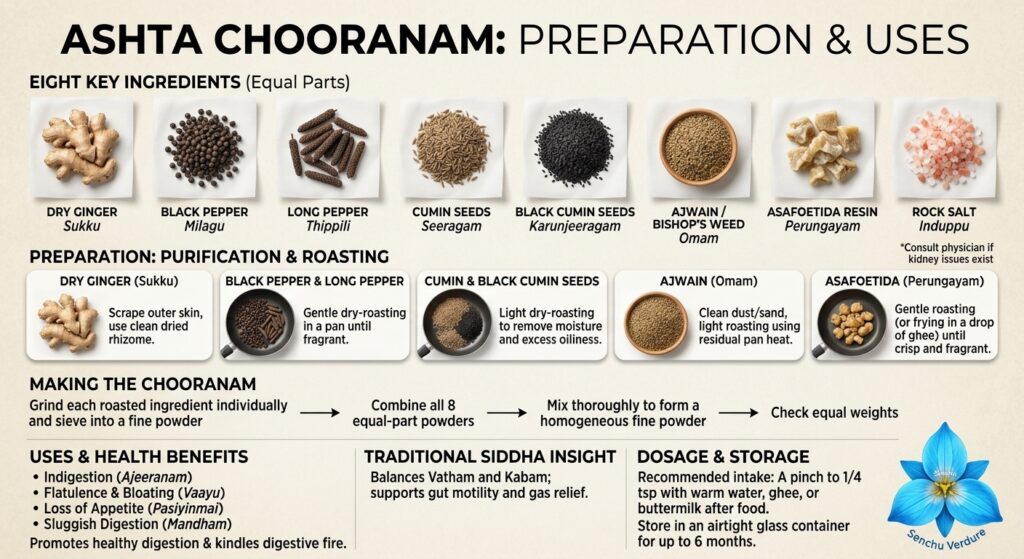
In a South Indian kitchen, the spice box is never merely an assortment of flavorings—it is a living pantry cabinet kept within arm’s reach of the hearth. As someone who tends herbs and watches how plants store sunlight, volatile oils, and resilience through changing seasons, I am endlessly drawn to how ancient Tamil scholars read the language of seeds. Long before modern laboratories isolated digestive enzymes and phytochemicals, Tamil Siddhars understood exactly how specific roots, berries, and resins speak to our internal fire.
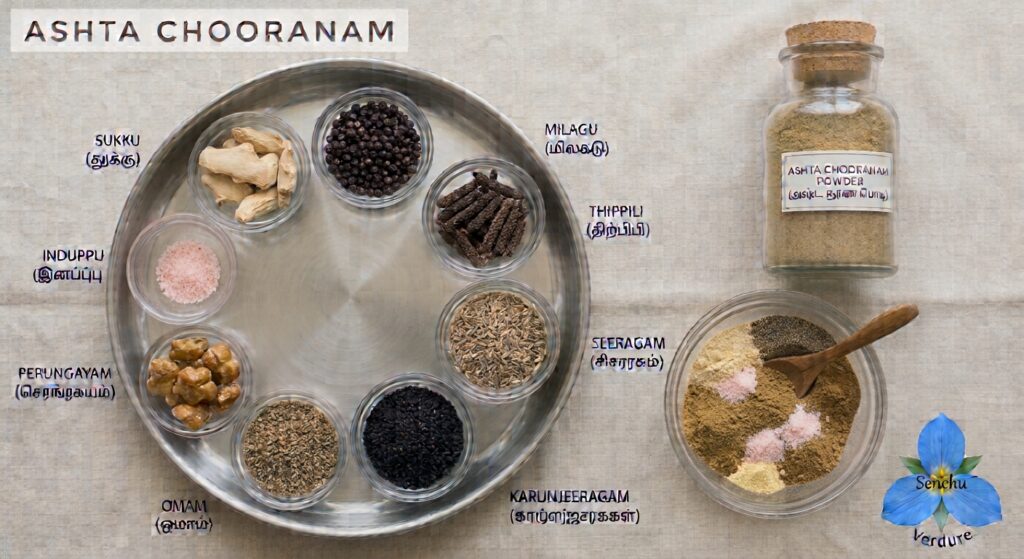
Among the most revered everyday formulations in classical Tamil Siddha tradition is Ashtachooranam (Ashtameaning eight, Chooranam meaning finely sieved medicinal powder). Built on the quiet harmony of seven botanicals measured in equal parts by weight, balanced with Indhuppu (natural rock salt) added to taste, this eight-ingredient blend shows how humble culinary staples work together to settle restless wind (Vatham), temper excess heat (Pitham), and clear sluggish phlegm (Kabam) across the digestive tract.
Ancient South Indian Botanical & Siddha Roots
In classical Tamil heritage, nourishment and medicine have never been separate conversations. Long before an illness takes root in the body, Tamil Siddha wisdom looks directly at how cleanly we transform our daily food. As the Tamil sage Thiruvalluvar observed in the Thirukkural (Marundhu, Chapter 95, Kural 942):
“Marundhena Vaendaavaam Yaakkaikku Arundhiyadhu Attradhu Potri Unin.”
(No medicine is needed for the body if one eats only after ensuring that what was eaten earlier has been completely digested.)
Classical Tamil Siddha compendiums—including Agathiyar Gunavagadam and Pathartha Guna Cinthamani—classify these eight pantry staples by their Suvai (taste), Veeriyam (thermal potency), and Pirivu (post-digestive transformation). Rather than relying on a single harsh stimulant, Ashtachooranam layers aromatic seeds, pungent peppers, tree resin, and a measured touch of natural mineral salt so each botanical unlocks the bioavailability of the next.
Inside the Eight Pantry Ingredients: Classical Siddha Verses & Western Physiology
In traditional preparation, the first seven botanicals are measured in equal parts by weight (1:1:1:1:1:1:1), while the eighth ingredient—Indhuppu (natural rock salt)—is added to taste. Each carries its own classical Tamil Gunavagadam tribute and distinct physiological role:
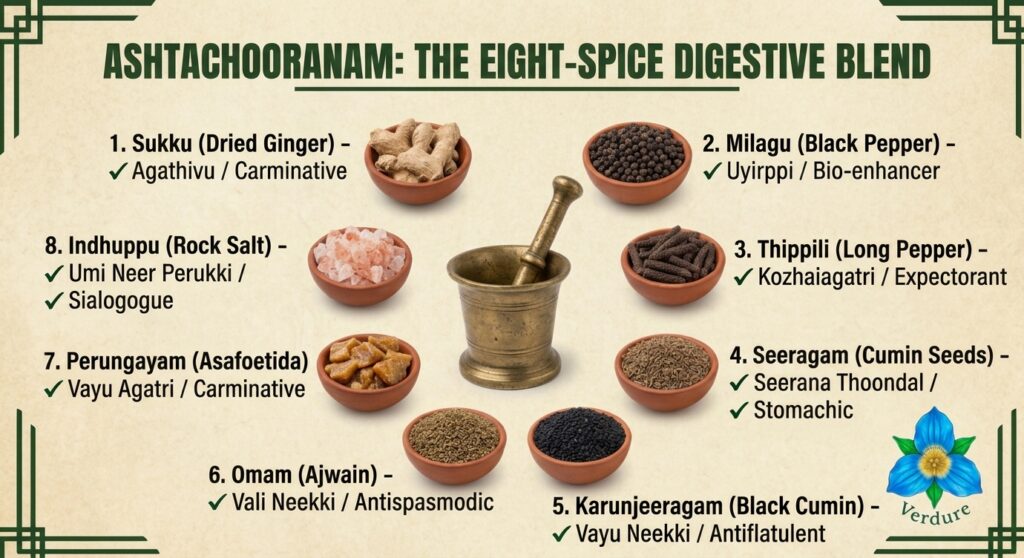
- 1. Sukku (Zingiber officinale — Peeled Dried Ginger):
Classical Siddha Verse (Agathiyar Gunavagadam):“Sukku Illaadha Kashaayam Undaa?”
(Is there ever a medicinal decoction worthy of the name without dried ginger?)
Known in Siddha pharmacology as an Agathivu and Pasithee Thoondal (Carminative and Digestive Stimulant), dried ginger is the steady engine of the formula. Its concentrated gingerols and shogaols encourage smooth gastric motility and support timely stomach emptying without irritating the delicate lining. - 2. Milagu (Piper nigrum — Black Pepper):
Classical Siddha Verse (Pathartha Guna Cinthamani):“Paththu Milagu Irundhaal Pagaiyan Veettilum Unnalaam.”
(With ten black peppercorns in hand, one may safely dine even in the house of an adversary.)
Acting as an Uyirppi and Seerana Thoondal (Bio-enhancer and Stomachic), black pepper awakens sluggish digestive secretions. Modern biochemistry shows that its active alkaloid, piperine, stimulates pancreatic digestive enzymes—amylase, lipase, and trypsin—while slowing liver breakdown so the beneficial compounds in the other spices absorb cleanly. - 3. Thippili (Piper longum — Long Pepper):
Classical Siddha Verse (Agathiyar Gunavagadam):“Kabam Ellaam Pokki Pasithee Valarkkum Thippili.”
(Long pepper clears accumulated phlegm and steadily kindles the digestive flame.)
Revered as a Kozhaiagatri and Veppam Undaakki (Expectorant and Thermogenic), long pepper reaches deeper into respiratory and metabolic pathways. Its piperlongumine and piperine promote peripheral microcirculation, clear damp mucosal stagnation (Kabam), and assist healthy liver metabolism. - 4. Seeragam (Cuminum cyminum — Cumin Seeds):
Classical Siddha Verse (Pathartha Guna Cinthamani):“Seeragam Illaa Unavu Sirappuraadhu; Udal Seer Aakkum.”
(No meal attains true perfection without cumin; it sets the inner body right.)
Even its Tamil name—Seer + Agam—translates literally to “that which harmonizes the interior.” Acting as a Seerana Thoondal and Pitham Thanippi (Stomachic and Cooling Carminative), cumin provides cuminaldehyde to prompt bile flow and digestive juices while gently softening the sharp heat of the three peppers. - 5. Karunjeeragam (Nigella sativa — Black Cumin Seeds):
Classical Siddha Verse (Agathiyar Gunavagadam):“Karunjeeragam Vayu Noi Yaavum Kadindhu Ozhikkum.”
(Black cumin swiftly drives away every disorder born of trapped internal wind.)
Valued as a Vayu Neekki and Krimi Nasini (Antiflatulent and Anthelmintic), these tiny jet-black seeds carry thymoquinone and aromatic volatile oils that calm intestinal fermentation, protect mucosal integrity, and discourage unwanted microbial overgrowth. - 6. Omam (Trachyspermum ammi — Ajwain / Carom Seeds):
Classical Siddha Verse (Agathiyar Gunavagadam):“Omam Ennum Marundhu Udhal Vali Ellaam Neekkum.”
(The medicine called Omam dispels abdominal tightness and colicky pain.)
Functioning as a swift Vali Neekki and Agathivu (Antispasmodic and Carminative), Omamowes its unmistakable aroma to natural thymol, which relaxes smooth muscle tension along the intestinal wall and supports healthy gastric acid secretion. - 7. Paal Perungayam (Ferula assa-foetida — Dry-Toasted Milk Asafoetida):
Classical Siddha Verse (Pathartha Guna Cinthamani):“Perungayam Vayu Kalai Periyadhoru Marundhaam.”
(Asafoetida stands as a supreme remedy for dispersing stubborn internal wind.)
Using pure Paal Perungayam (white, milky resin) gently dry-toasted on a kadai without any ghee preserves its clean potency as a premier Vayu Agatri and Kudar Vali Neekki(Carminative and Antispasmodic). Its ferulic acid and sulfur-rich sesquiterpenes rapidly disperse trapped colonic gas (Vatham) and ease abdominal tightness. - 8. Indhuppu (Halite — Natural Rock Salt, Added to Taste):
Classical Siddha Verse (Gunapadam Thathu Jeeva Vaguppu):“Uppillaa Pandam Kuppaiyile; Indhuppu Uyirukku Urudhi.”
(Food without salt belongs in the discard; rock salt brings steady vitality to life.)
Added judiciously to taste rather than in full equal weight, natural rock salt serves as an Umi Neer Perukki and Suvai Undaakki (Sialogogue and Digestive Catalyst). It wakes up the palate on contact, triggering immediate saliva flow while supplying trace minerals and chloride ions essential for stomach acid synthesis.
The Thirithodam & Siddha–Western Connection
In Tamil Siddha physiology, lasting health rests on the dynamic equilibrium of the three life humors—Vatham(wind and movement), Pitham (fire and transformation), and Kabam (water-earth and structure). As the Siddha sage Theraiyar states in his classical work Theraiyar Yamaga Venba:
“Vatham Aladhu Pitham Aladhu Kabam Aladhu Thodam Illai.”
(Without the derangement of Vatham, Pitham, or Kabam, no imbalance or disease can arise in the body.)
Ashtachooranam is engineered specifically to keep all three humors steady at the very start of digestion. The warming trio of Sukku, Milagu, and Thippili (Thirikatugu) generates focused metabolic warmth (Ushnam) to clear cold dampness and mucus (Kabam). At the same time, Seeragam and a balanced touch of Indhuppukeep the blend grounded so it does not flare Pitham (excess heat, burping, or acidity), while Paal Perungayam, Omam, and Karunjeeragam settle scattered Vatham (gas and cramping).
Viewed through modern gut physiology, the aromatic essential oils in Omam and Seeragam awaken lingual and olfactory receptors that signal the vagus nerve, shifting the autonomic nervous system into a calm parasympathetic “rest-and-digest” rhythm. Simultaneously, piperine from Milagu and Thippili boosts enzymatic secretion and intestinal nutrient transport, mirroring what Siddhars described centuries ago as Pasithee Thoondal (kindling the digestive flame).
Traditional Preparation Method
- Measure the Proportions: Weigh out equal parts (1:1:1:1:1:1:1) of the seven botanical ingredients (Sukku, Milagu, Thippili, Seeragam, Karunjeeragam, Omam, and Paal Perungayam), and set aside a small amount of Indhuppu (natural rock salt) to season to taste.
- Dry-Toast the Paal Perungayam: Place the Paal Perungayam into a heavy, completely dry kadai over low heat—with no ghee or oil—and toast gently until it turns crisp, fragrant, and dry enough to crumble easily. Set aside to cool completely.
- Dry-Roast the Remaining Botanicals: In the dry kadai over low heat, gently warm peeled Sukku(crushed into small pieces), Milagu, Thippili, Omam, Seeragam, and Karunjeeragam separately just until fragrant and crisp—never browned or scorched—so their delicate volatile oils remain intact.
- Pulverize, Season & Sieve: Grind the cooled spices and Paal Perungayam together with Indhuppu(added to taste) into a fine powder. Pass the blend through a fine mesh sieve (Vasthira Kaayam / traditional cloth-sieving method) until silky and uniform.
- Store: Keep in an airtight glass or ceramic jar away from direct sunlight and kitchen steam.
Traditional Serving: Blend ¼ to ½ teaspoon (roughly 1 to 2 grams) of Ashtachooranam with a few drops of warm ghee and take it with the first morsel of warm rice at lunch, or stir into warm water or spiced buttermilk (Neer Mor).
Attribution & Lineage Credit
Formulation principles, traditional Tamil pharmacological classifications, and Siddha clinical insights are gratefully credited to Siddha Physician Dr. Saalai Jaya Kalpana and SMARTA Academy.
Educational & Medical Disclaimer
The information shared in this post is for educational and cultural exploration only and is not intended to diagnose, treat, cure, or prevent any medical condition. Always consult a qualified Siddha physician or healthcare practitioner before introducing concentrated herbal formulations into your routine, especially if you are pregnant, nursing, taking prescription medications, or managing high blood pressure or gastrointestinal conditions.