
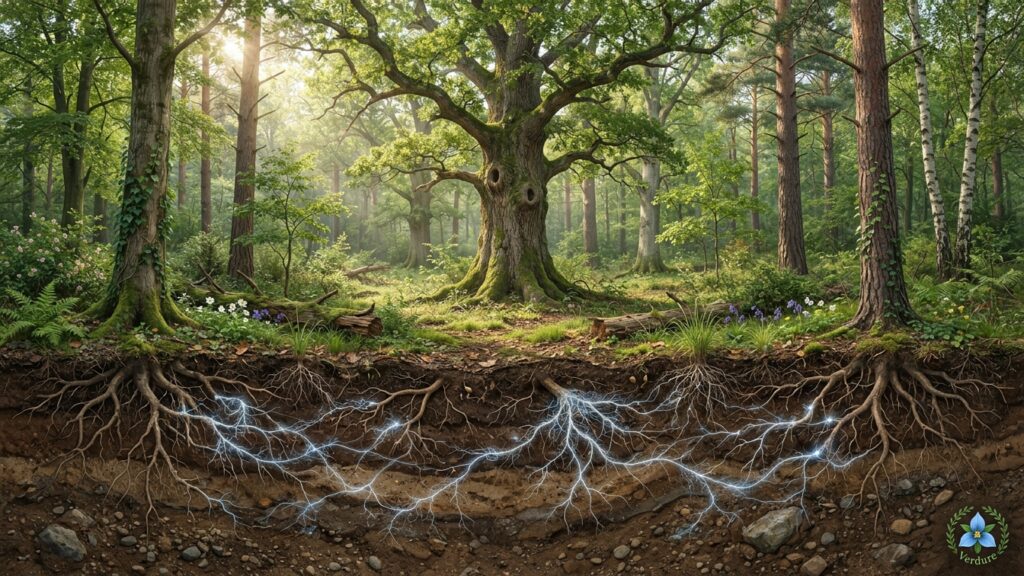
The next time you walk through a park, hike a trail, or sit beneath a tree in your backyard, observe the flora around you. For centuries, our cultural narrative has painted the plant realm as a passive backdrop to the animal world. We traditionally view a forest through a hyper-competitive lens—a collection of isolated individuals locked in a brutal race for sunlight, nutrients, and water.But beneath your boots, a wild, hidden, and deeply integrated conversation is taking place. Over the past few decades, a quiet revolution has been brewing in the botanical sciences. Groundbreaking discoveries are forcing us to redefine what it means to be alive, to communicate, and to possess intelligence. Today, we are going down the rabbit hole of how plants hear, hunt, remember, and run a subterranean internet—revealing a truth that ancient Dravidian poets and Siddha sages mapped out thousands of years ago.
The Wood Wide Web: Nature’s Internet
To understand how social plants really are, you have to look down. Deep beneath the forest floor lies the Common Mycorrhizal Network (CMN), an intricate, miles-long underground web of fungal threads that connects the root systems of an entire forest ecosystem. Pioneering forest ecologists have completely shattered the old myth of the solitary tree. Research conducted by Dr. Suzanne Simard at the University of British Columbia reveals that the CMN acts as a vast infrastructure for a highly cooperative society. Through this fungal network, trees don’t just hoard resources; they trade them like currency. For instance, Douglas firs and paper birch trees alternate exchanging carbon and sugars through the fungi, depending on who has a seasonal excess and who faces a deficiency.Furthermore, the oldest, largest trees in a forest act as central hubs. These “Mother Trees” use the network to map out their surroundings, detect their own kin, and intentionally pump life-saving sugars and nutrients to shaded, struggling seedlings. While parasitic plants can “hack” into the network to steal resources and trees like the black walnut send out targeted toxins to discourage competition, the network primarily functions as a collective safety net. The healthier the whole forest is, the more every individual member benefits.
Lighting the Lookout Towers: Advanced Defense
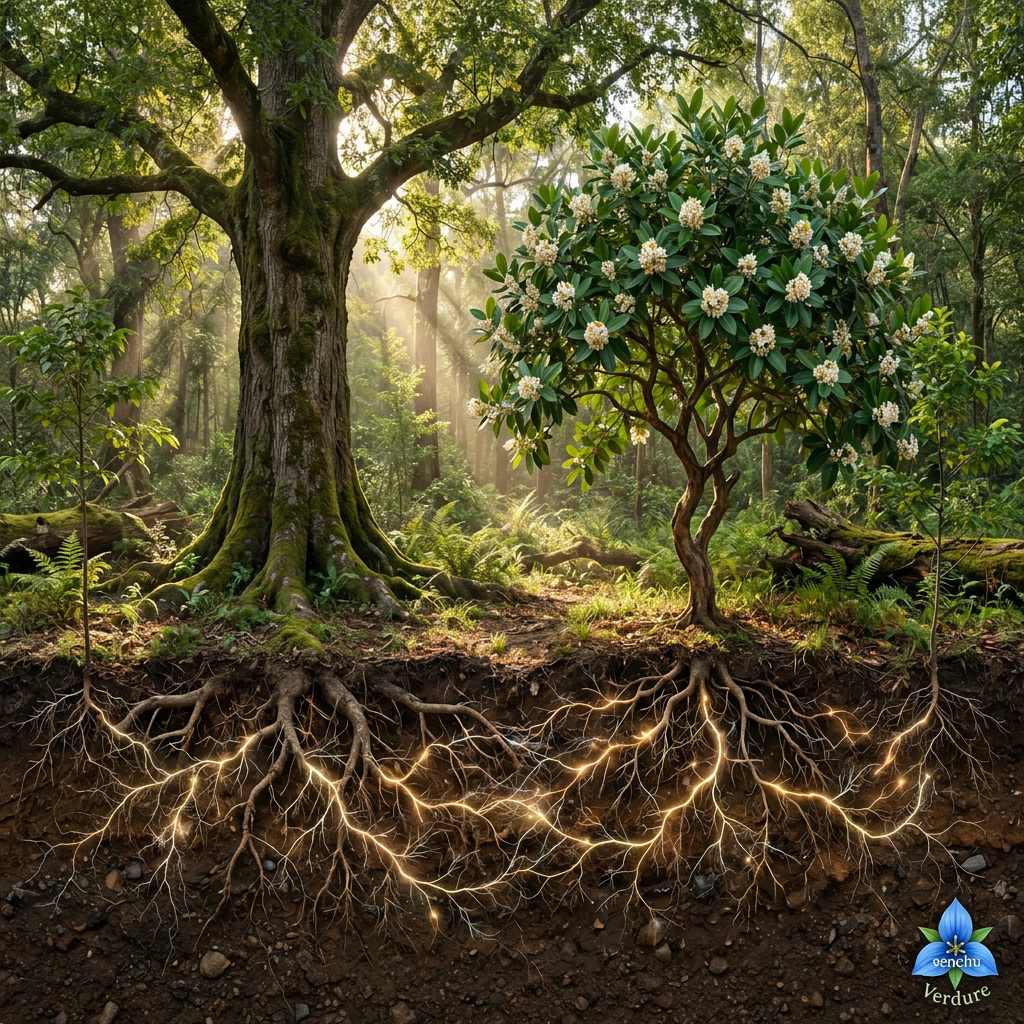
Imagine a massive military base where a breach at the perimeter fence instantly triggers a lockdown across the entire facility. That is exactly how a plant responds to an attack, but its warning systems extend far beyond its own physical body. When a grazing animal or a swarm of aphids begins munching on a plant’s leaves, the plant deploys immediate defense tactics. It recognizes the specific threat and spikes its internal production of defensive phytochemicals, such as bitter tannins, to make its leaves unpalatable or toxic to the attacker. But it doesn’t stop there. The attacked plant immediately sounds the alarm for its neighbors using two distinct communication channels. First, it utilizes airborne chemical warfare, releasing volatile organic compounds into the air. When neighboring plants “smell” these floating chemicals, they interpret them as an incoming threat and proactively increase their own defensive chemicals preventatively. At the same time, the plant shoots a chemical SOS message straight down through the Common Mycorrhizal Network, prompting linked neighboring plants to shore up their defenses within minutes.
The Senses You Didn’t Know You Had
To interact with the world so dynamically, plants must perceive it. While they lack eyes, ears, and noses, they possess biological equivalents that are astonishingly precise.Plants are remarkably attuned to acoustic vibrations. Researchers discovered that when flowering plants are exposed to the acoustic frequency of a buzzing bee’s wings, the flowers act like an auditory sensory organ. Within just three minutes of “hearing” a pollinator nearby, the plant dynamically increased the sugar concentration of its nectar by 20% to make itself more attractive. Conversely, plants can isolate the sound of danger. They can distinguish between the harmless vibration of the wind and the specific chewing frequency of a caterpillar eating a leaf, triggering a localized chemical defense only when they hear the predator.
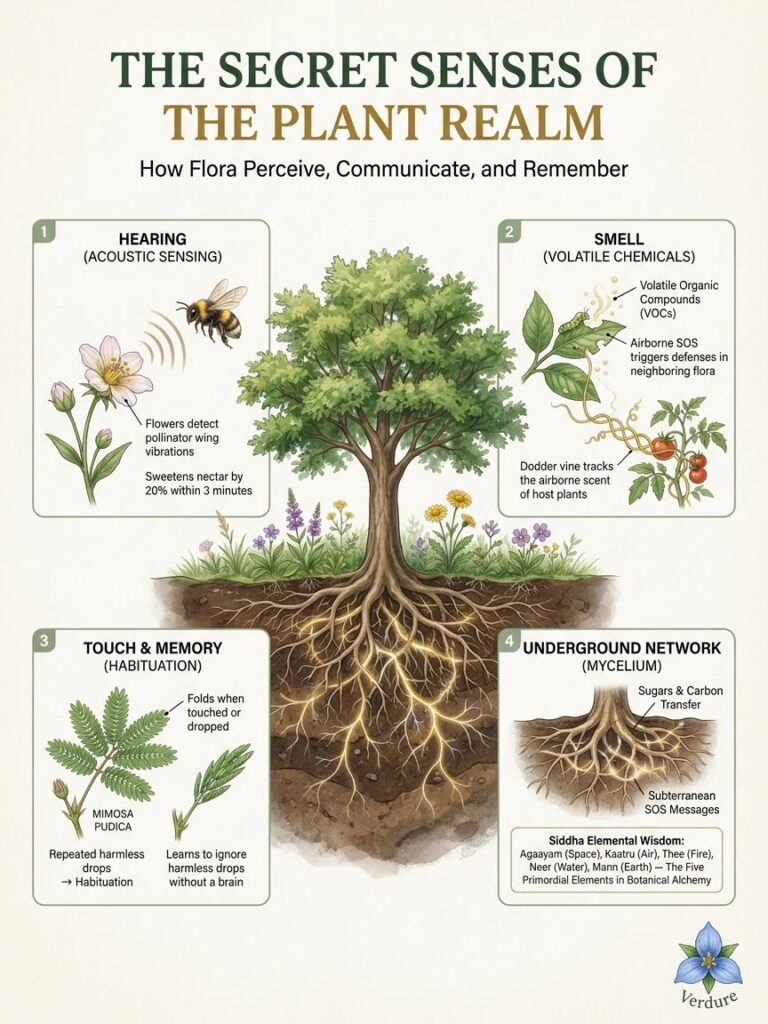
We also usually think of plants as passive recipients of whatever nutrients happen to float by their roots, but some plants are active predators. Take the parasitic dodder plant (Cuscuta spp.). It has almost no chlorophyll and cannot photosynthesize effectively, so it survives by hunting. Repeated experiments show that the dodder plant can “smell” the specific airborne chemicals released by its preferred prey—a tomato plant. Once it catches the scent, it uses a circular sweeping motion to navigate through space, growing directly toward its victim to latch on and drain its nutrients.
Furthermore, plants possess an incredible capacity for elementary learning and memory without a brain. Consider Mimosa pudica, a unique perennial plant famous for rapidly folding its leaves inward when touched or dropped as a defense mechanism. In a classic behavioral experiment, scientists built a custom apparatus that repeatedly dropped the Mimosa plants from a short height. After a few consecutive drops, the plants realized the fall wasn’t causing them physical harm, and they stopped closing their leaves—they had habituated to the stimulus. To test if this was just physical exhaustion, the scientists touched the leaves manually, and the plant immediately snapped shut. It had learned that dropping was safe and retained this memory for over a month.
Furthermore, plants possess an incredible capacity for elementary learning and memory without a brain. Consider Mimosa pudica, a unique perennial plant famous for rapidly folding its leaves inward when touched or dropped as a defense mechanism. In a classic behavioral experiment, scientists built a custom apparatus that repeatedly dropped the Mimosa plants from a short height. After a few consecutive drops, the plants realized the fall wasn’t causing them physical harm, and they stopped closing their leaves—they had habituated to the stimulus. To test if this was just physical exhaustion, the scientists touched the leaves manually, and the plant immediately snapped shut. It had learned that dropping was safe and retained this memory for over a month.
Ancient Dravidian Roots: Sangam Kinship and Siddha Science
When we contrast modern Western botany with ancient South Indian frameworks, we discover that what science is proving in laboratories today was lived, sung, and practiced thousands of years ago in Tamil literature and Siddha medicine.
In classical Sangam literature, the plant realm is never treated as silent scenery; it is recognized as a sentient, relational community. Sangam poets organized the entire natural world into five ecological landscapes—mountains, forests, farmlands, seashores, and arid lands—each named after a native flower or tree. This framework understood that soil, water, climate, flora, and human emotion form a single, responsive web of life. Even more remarkably, Sangam poetry speaks of direct family kinship with trees. In a celebrated verse from the classical anthology Natrinai, a young woman recounts how her mother raised a Punnai (Alexandrian laurel) tree alongside her as her own elder sister:

நும்மினும் சிறந்தது நுவ்வை ஆகும் என்று
அன்னை கூறினள் புன்னையது சிறப்பே
“Our mother told us that this Punnai tree is even more special than you, for she is your own elder sister.” — Classical Sangam Anthology (Natrinai, Verse 172)
To the Sangam mind, trees possessed presence, memory, and emotional awareness worthy of sisterly reverence.
This poetic intimacy was matched by the rigorous elemental science of the Tamil Siddha tradition. The 18 Maha Siddhars viewed plants not as inert organic matter, but as intelligent alchemical filters woven from the five primordial elements: Agaayam (Space), Kaatru (Air), Thee (Fire), Neer (Water), and Mann (Earth). They understood that flora possess an innate biological intelligence to absorb, transmute, and purify compounds from their surroundings to synthesize life-saving medicine.
This sensory and alchemical nature raises a vital ecological question: does this intelligence make plants superior environmental purgers, or does it make them vulnerable to pollution? The truth is a double-edged sword. Because plants are anchored to one spot, they have evolved an extraordinary capacity to process and adapt to environmental toxins—a process modern science calls phytoremediation. Yet because a plant continuously drinks in the earth, water, and air around it, a contaminated environment forces the plant’s decentralized intelligence to sequester heavy metals and pollutants inside its cell walls to survive. While the plant endures, it can pass those accumulated toxins up the food chain. That is precisely why Siddha wisdom insists on harvesting medicinal herbs only from pure, uncorrupted soil; when the five elements are compromised, the plant’s natural alchemy is overwhelmed.

The Great Scientific Convergence
This explosion of historical and contemporary data has sparked a profound shift in biology. A pioneering field known as plant neurobiology argues that because plants perceive, interpret, store information, and make flexible decisions, they meet the objective definitions of intelligence. Mainstream critics once argued that words like “learning” or “memory” over-anthropomorphized flora.
However, pioneers like Dr. Stefano Mancuso, author of The Revolutionary Genius of Plants, point out that our definition of intellect is dangerously animal-centric. Animals evolved a centralized brain because they must move quickly to escape danger. Plants cannot run away. If a plant relied on a single centralized brain, one bite from a grazing animal would end its existence. Instead, plants evolved a distributed intelligence. Every root tip, leaf, and stem processes sensory data simultaneously—allowing a plant to lose up to 90% of its physical body and still function, remember, and navigate its world.
Closing Reflection: A Living Tapestry of Creation
By looking at the forest through both modern ecology and ancient Dravidian wisdom, we arrive at the same enduring truth: a forest is not a battlefield of isolated rivals, but a single, breathing superorganism bound together by mutual care. As naturalists have long observed when studying the quiet architecture of the wild:
“In every walk with nature one receives far more than he seeks.” — John Muir
What Sangam poets honored as sisterhood with the trees and Siddha sages studied as elemental intelligence finds its deepest spiritual echo in Scripture:
“Ask the animals, and they will teach you, or the birds in the sky, and they will tell you; or speak to the earth, and it will teach you, or let the fish in the sea inform you. Which of all these does not know that the hand of the Lord has done this?” — Job 12:7–9
When we slow down and listen to the plant realm—from the deepest fungal thread beneath the soil to the smallest blossom opening to the sun—we are reminded that creation thrives not through isolation, but through kinship, generosity, and silent, faithful connection.
Explore more on how ancient botanical wisdom connects with everyday living—stay tuned as we continue developing our series on the subtle senses of the plant realm.
References
- Kalske, A., et al. (2019). Insect Herbivory Selects for Volatile-Mediated Plant-Plant Communication. Current Biology, 29(18), 3128–3133.
- Mancuso, S. (2018). The Revolutionary Genius of Plants: A New Understanding of Plant Intelligence and Behavior. Atria Books.
- Natrinai (Classical Sangam Anthology), Verse 172.
- Simard, S. W., et al. (1997). Net transfer of carbon between ectomycorrhizal tree species in the field. Nature, 388(6642), 579–582.
- Veits, M., et al. (2019). Flowers respond to pollinator sound within minutes by increasing nectar sugar concentration. Ecology Letters, 22(9), 1483–1492.