Every autumn across the plant realm, a quiet, intentional transformation unfolds. What looks to the passing eye like the fading of summer is actually a deliberate, energy-saving masterpiece of botanical chemistry—one that divides the forest into two distinct survival philosophies.
The Retreat of Chlorophyll
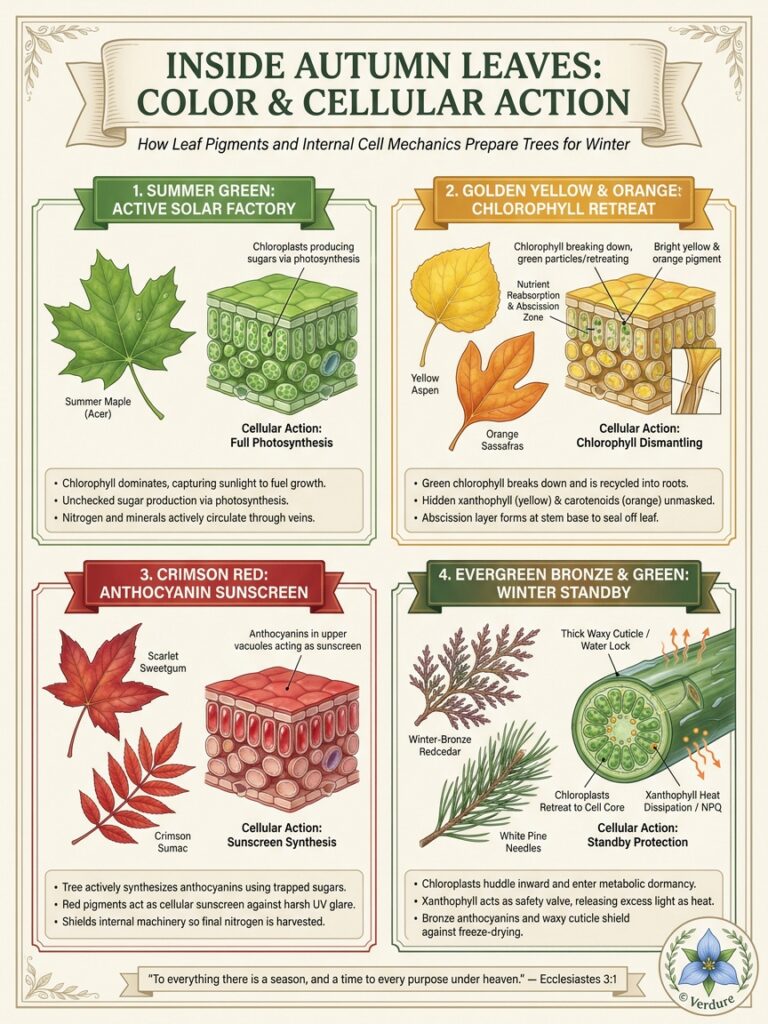
Throughout spring and summer, leaves act as bustling solar factories, powered by chlorophyll—the rich green pigment that captures sunlight to fuel growth. As the days shorten and temperatures cool, deciduous trees sense the coming winter. Rather than letting precious nutrients freeze and drop to the ground, the tree begins sealing off the connection between the leaf stem and the branch, slowly dismantling its green chlorophyll and drawing vital nitrogen and minerals back into its roots and trunk for safekeeping.
Unmasking Xanthophyll and Carotenoids
As the dominant green curtain of chlorophyll pulls back, pigments that were quietly present inside the leaf all summer long finally step into the light. Xanthophyll (which gives leaves their luminous yellows) and carotenoids (responsible for warm oranges) have been working behind the scenes all season, helping absorb light energy and protecting the leaf from sun damage. Once chlorophyll retreats, these golden hues shine through unhindered.
Turning Red on Purpose: The Role of Anthocyanins
Unlike yellows and oranges, the brilliant scarlets, burgundies, and deep purples of autumn are not merely uncovered—they are actively manufactured at the end of the season. As sugars become trapped in the leaf during cool nights and bright, sunny days, the plant synthesizes anthocyanins.
Far from being accidental, producing anthocyanins takes energy. Botanists observe that these crimson pigments act as a natural sunscreen, shielding the leaf’s delicate internal machinery from intense autumn light while the tree finishes reabsorbing its last reserves of nutrients. In the plant realm, turning red is an act of purposeful stewardship—protecting the final harvest before letting go.
Evergreens in the Fall: Putting the Green Engine on Standby
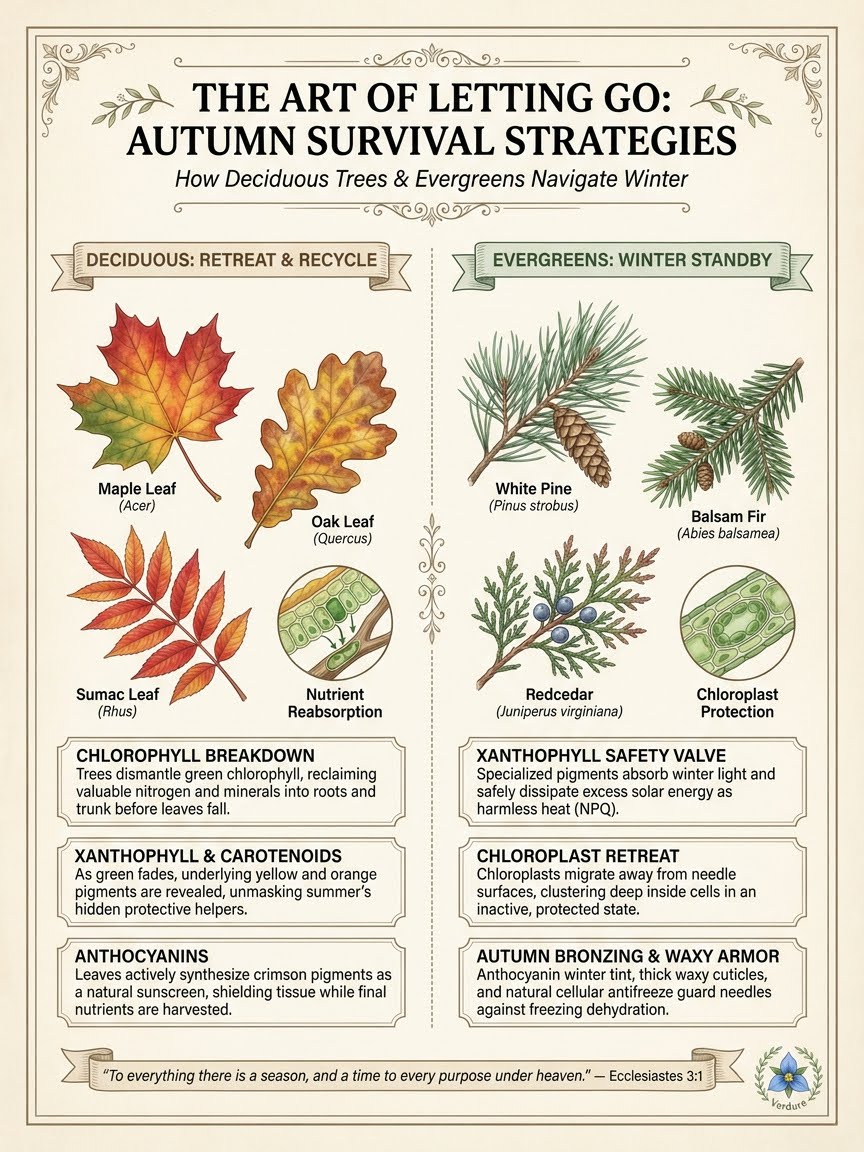
While maples and oaks salvage their nitrogen and release their leaves, evergreens—such as White Pine, Balsam Fir, and Redcedar—take the opposite approach. Rebuilding an entire canopy from scratch each spring is metabolically costly, so evergreens keep their green chlorophyll intact all winter by putting it into a protective standby mode:
- The Xanthophyll Safety Valve. Winter sunlight remains bright even when freezing air stalls the leaf’s energy-processing assembly line. To prevent incoming light from overloading exposed chlorophyll, evergreens ramp up xanthophyll pigments to intercept excess solar energy and release it safely as harmless heat.
- Retreating Inside the Cell. Inside evergreen needles, chloroplasts pull away from the sunlit upper surface and cluster deeper inside the cell, shielding one another while protective proteins lock chlorophyll into an inactive, resting state.
- Subtle Autumn Bronzing. Many evergreens—including Redcedar, Arborvitae, and Boxwood—shift from summer green to a muted bronze or plum in late fall. Like deciduous leaves, they flood their outer cells with anthocyanins as a winter sunscreen until spring warmth returns.
- Waxy Armor and Cellular Antifreeze. Narrow needles sealed in thick wax minimize moisture loss when soil freezes solid, while concentrated sugars and antifreeze proteins keep ice crystals from piercing delicate chloroplast membranes.
A Lesson in Stewardship and Renewal
In watching deciduous trees release what they no longer need while evergreens guard what is vital through the frost, we see a timeless truth reflected in creation. Scripture reminds us in Ecclesiastes 3:1 that “To everything there is a season, and a time to every purpose under heaven.” Just as every tree answers the turning of the year according to its design, we too are invited to release the old, guard what is vital, and rest in the faithfulness of the Creator who sustains every season.