When we open the pages of the Hebrew Scriptures, we often read them through the lens of human history—kings, prophets, journeys, and covenants. Yet woven quietly into every valley, wilderness, sea, and sky of the biblical narrative is an extraordinary tapestry of living creatures. From the smallest pollinator hummed about in the Judges’ riddles to Behemoth in the river reeds and the great sea dragons of the deep, the Hebrew text observes the natural world with remarkable precision.
(Note: This article is based entirely on the original Hebrew version of the Scriptures.)
Over the centuries, as the Bible was translated from Hebrew into Greek, Latin, and English, many animal names were altered or broadened in translation. Translators working in northern Europe, far removed from the deserts, marshes, and wildlife of the ancient Levant, often substituted familiar European creatures or umbrella terms for specific Middle Eastern species—turning distinct desert vipers into generic “adders,” transforming the Hebrew great fish (dag gadol) into a “whale,” or rendering untranslatable giants like Behemoth and Leviathan in varying ways.
Returning to the original biblical Hebrew names restores what was softened in translation. In Hebrew thought, a name is never merely a label; it captures the creature’s exact movement, sound, habitat, and purpose placed within it by its Maker.
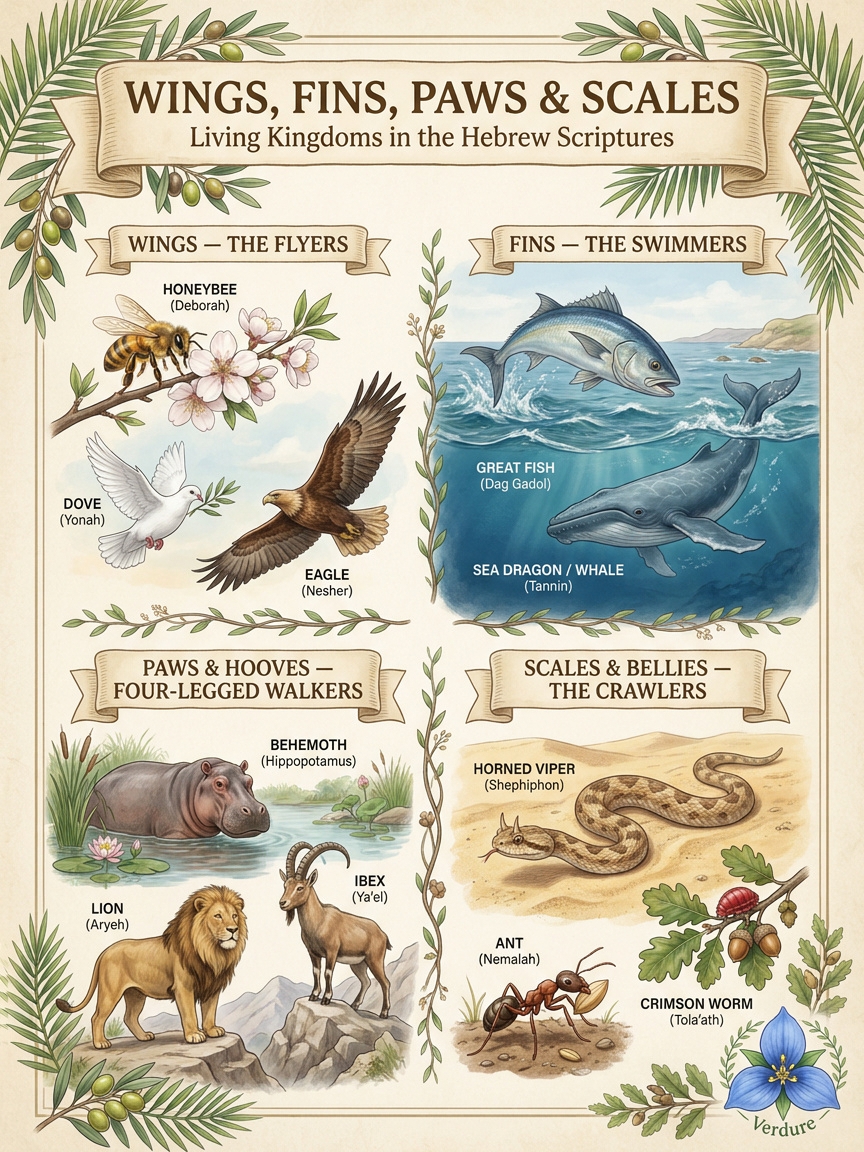
In Genesis 1, creation is organized not by modern taxonomy, but by the distinct realms in which creatures move and dwell: the Flyers (Oph) of the open expanse, the Swimmers (Sherets ha-Mayim and Tanninim) teeming in the waters, and the Four-Legged Walkers (Behemah and Chayyah) and Crawlers (Remes) moving across the dry ground. Exploring these four living kingdoms—wings, fins, paws, and scales—one creature at a time reveals how deeply Scripture connects every design to the flourishing of the plant realm and the wisdom of the Creator.
1. Wings — The Flyers (Oph): Messengers of the Sky and Pollinators of the Land
In the Hebrew Scriptures, the creatures of the air (Oph, from a root meaning “to cover with wings”) span everything from tiny winged insects to soaring raptors and migratory waterbirds.
- The Honeybee (Deborah / דְּבוֹרָה): Derived from the Hebrew root ד-ב-ר (d-b-r), meaning both “to speak the word” and “to arrange in order,” the honeybee reflects intricate hive harmony and purposeful industry. In Judges 14, Samson finds golden honey inside a lion’s carcass, while throughout Scripture bees pollinate the almond blossoms, pomegranates, wild thyme, and fig trees of the Levant. Remarkably, the prophetess and judge Deborah (Judges 4–5) bears this exact name, sitting beneath the Palm of Deborah (Tomer Deborah / Phoenix dactylifera) to speak God’s word, bring order to Israel, and usher in forty years of sweet peace.
- The Dove (Yonah / יוֹנָה): From a root associated with “mourning” or “cooing,” the dove returns to Noah’s ark in Genesis 8 bearing a freshly plucked olive leaf (Olea europaea), signaling that the earth’s flora had begun to regenerate and peace had returned to the soil.
- The Turtledove (Tor / תֹּר): Named after its soft, rhythmic tur-tur call, this migratory bird marks the arrival of spring in Song of Solomon 2:12 (“the voice of the turtledove is heard in our land”), linking seasonal phenology with floral renewal.
- The Raven (Oreb / עוֹרֵב): Rooted in the word for “evening” or “darkness” (ereb), referring to its glossy black plumage, the raven was the first bird sent from Noah’s ark (Genesis 8:7) and later served as God’s courier to feed Elijah by the Brook Cherith (1 Kings 17:4–6).
- The Eagle (Nesher / נֶשֶׁר): Linked to a root meaning “to tear” or “to soar swiftly,” the eagle (or griffon vulture) embodies majestic strength, thermal soaring, and high-crag nesting in Exodus 19:4, Job 39:27, and Isaiah 40:31.
- The Hawk (Netz / נֵץ): From a root meaning “to flash” or “fly rapidly,” Job 39:26 celebrates the hawk’s built-in migratory instinct as it stretches its wings toward the south.
- The Falcon (Ayah / אַיָּה): Associated with sharp, keen eyesight, Job 28:7 marvels that “the falcon’s eye has not seen” the hidden paths beneath the earth where precious minerals lie.
- The Stork (Chasidah / חֲסִידָה): Derived directly from the Hebrew word חֶסֶד (chesed), meaning “loyal love” or “kindness,” because of the stork’s devoted care for its young. Jeremiah 8:7 notes that “the stork in the heavens knows her times,” honoring her unfailing seasonal migration.
- The Crane (Agur / עָגוּר) and The Swift (Sis / סִיס): Named for their distinct vocal calls (“like a swallow or a crane I chirp,” Isaiah 38:14), both birds are cited in Jeremiah 8:7 for keeping their appointed seasons with precision.
- The Swallow (Deror / דְּרוֹר): Sharing its Hebrew root with the word for “liberty” or “freedom” (deror), the darting, free-flying swallow builds its nest safely near the altars of the Lord in Psalm 84:3.
- The Sparrow (Tzippor / צִפּוֹר): Coming from a root meaning “to chirp” or “twitter early in the morning,” tzippor is the joyful emblem of small, fluttering songbirds finding shelter in the house of God (Psalm 84:3).
- The Quail (Selav / שְׂלָו): Rooted in a term meaning “plump” or “at ease,” vast flocks of migratory quail were blown in from the sea to sustain Israel in the wilderness (Exodus 16:13; Numbers 11:31).
- The Partridge (Qore / קוֹרֵא): Literally meaning “the caller,” named for its resonant cry across rocky hillsides, referenced in 1 Samuel 26:20 when David compares himself to a partridge hunted in the mountains.
- The Ostrich (Ya’anah / יַעֲנָה): Linked to a root meaning “greedy” or “harsh-voiced,” Job 39:13–18 highlights the ostrich’s astonishing running speed—laughing at both horse and rider—and her rugged desert nesting habits.
- The Peacock (Tukki / תֻּכִּי): Imported from distant lands aboard King Solomon’s merchant fleet (1 Kings 10:22), showcasing the exotic beauty of creation gathered in Jerusalem.
- The Owl (Yanshuph / יַנְשׁוּף & Kos / כּוֹס): Yanshuph connects to the Hebrew word for “twilight” (nesheph), marking the owl as a creature of dusk and night, while Kos (“cup”) refers to the small owl dwelling in desert ruins (Psalm 102:6).
- The Bat (Atalleph / עֲטַלֵּף): Meaning “flyer in the dark,” classified among winged creatures in Leviticus 11:19 and mentioned in Isaiah 2:20 as dwelling in caves and clefts.
- The Locust (Arbeh / אַרְבֶּה): Derived from the root ר-ב-ה (r-b-h), meaning “to multiply” or “become great in number,” capturing how locusts appear in vast swarms (Joel 1:4) yet march in orderly ranks without a king (Proverbs 30:27).
- The Grasshopper (Chagab / חָגָב): From a root meaning “to leap” or “bound,” used in Numbers 13:33 and Ecclesiastes 12:5 to illustrate smallness and frailty.
- The Hornet (Tsir’ah / צִרְעָה): Rooted in a verb meaning “to strike” or “sting,” sent ahead of Israel in Exodus 23:28 and Joshua 24:12 to drive out opposing forces.
- The Fly (Zebub / זְבוּב): An onomatopoeic Hebrew word echoing the buzzing z-b-b sound of swarming insects (Ecclesiastes 10:1; Isaiah 7:18).
- The Gnat (Ken / כֵּן): Rooted in a term meaning “to pinch” or “burrow,” representing the smallest of winged pests in Exodus 8:16–18.
- The Moth (Ash / עָשׁ): From a root meaning “to waste away” or “consume,” used in Job 4:19 and Isaiah 50:9 to depict quiet, gradual decay.
2. Fins — The Swimmers (Sherets ha-Mayim): Mysteries of the Waters Above and Below
From the freshwater ripples of the Sea of Chinnereth (Galilee) and the Jordan River to the depths of the Mediterranean (“the Great Sea”), the aquatic realm inspires awe and provision.
- Great Sea Creatures, Whales, and Sea Dragons (Tanninim / תַּנִּינִים): Derived from a root meaning “to stretch out” or “elongate,” tanninim describes massive, elongated marine creatures. In Genesis 1:21, these great whales and sea dragons are the very first creatures explicitly blessed by God, and in Psalm 148:7 they are summoned from the ocean depths to praise their Maker.
- The Great Fish (Dag Gadol / דָּג גָּדוֹל): From the Hebrew root ד-ג-ה (d-g-h), meaning “to multiply abundantly,” dag is the umbrella term for all prolific aquatic life. In Jonah 1:17 (2:1 in Hebrew numbering), a specially appointed dag gadol becomes an instrument of rescue rather than destruction, sheltering the prophet for three days.
- Leviathan (Livyatan / לִוְיָתָן): Rooted in the verb ל-ו-ה (l-w-h), meaning “to twist,” “coil,” or “wreathe,” Leviathan represents the untamable power of the deep ocean in Job 41 and Psalm 104:26—armored in tightly sealed rows of shields and scales that make the deep boil like a cauldron.
- Swarming Water Creatures (Dagim / דָּגִים): Celebrated in Psalm 8:8 and Ezekiel 47:9–10, where living waters flowing from the sanctuary bring forth teeming schools of fish—a vivid picture of ecological renewal.
3. Paws and Hooves — The Four-Legged Walkers (Behemah & Chayyah): Strength and Stewardship
The four-legged walkers encompass both wild beasts of the rivers and wilderness (Chayyah, from “life”) and domesticated herds (Behemah, from a root meaning “mute” or “beast of burden”).
- Behemoth / The Hippopotamus (Behemoth / בְּהֵמוֹת): The intensive plural of behemah—literally meaning “the Beast of Beasts”—identified in Job 40:15–24 with the hippopotamus of the Nile and Jordan marshes. Feeding on river grass like an ox, with bones like tubes of bronze, Behemoth rests beneath river lotus trees (Tse’elim) and reeds, standing unafraid even when a raging river surges against its mouth.
- The Lion (Aryeh / אַרְיֵה): Derived from a root meaning “to pluck” or “rend,” alongside poetic Hebrew titles like Kefir (young lion) and Labi (lioness). Roaming the thickets of the Jordan in biblical times, the lion embodies royal courage and strength (1 Samuel 17:34; Proverbs 30:30).
- The Leopard (Namer / נָמֵר): Rooted in a word meaning “spotted” or “variegated,” referenced in Jeremiah 13:23 (“Can the leopard change his spots?”) and Isaiah 11:6.
- The Bear (Dob / דֹּב): Associated with a root meaning “to move heavily” or “pad softly,” depicting the Syrian brown bear of Israel’s forested hills—especially fierce when protecting its cubs (2 Samuel 17:8; Proverbs 17:12).
- The Wolf (Ze’eb / זְאֵב): Linked to a root suggesting “yellowness” or “prowling swiftly,” representing nocturnal vigilance and ferocity (Habakkuk 1:8; Isaiah 11:6).
- The Fox (Shual / שׁוּעָל): Derived from a root meaning “to hollow out” or “burrow,” describing how foxes dig dens in ruins and roam blooming vineyards (Song of Solomon 2:15; Lamentations 5:18).
- The Jackal (Tan / תַּן): From a root meaning “to howl” or “stretch out,” depicting wild desert canines haunting arid wastelands (Job 30:29; Isaiah 34:13).
- The Rock Hyrax (Shaphan / שָׁפָן): Rooted in a verb meaning “to hide” or “conceal,” celebrated in Proverbs 30:26 as one of the four small things that are exceedingly wise—making its secure home in the crags of the rocks despite its small stature.
- The Hare (Arnebeth / אַרְנֶבֶת): A swift, herbivorous desert mammal listed among land creatures in Leviticus 11:6.
- The Stag / Hart (Ayal / אַיָּל): Sharing its Hebrew root with אֵל (el) and אַיִל (ayil), meaning “strength” and “power.” The sure-footed deer symbolizes agility on high places (Habakkuk 3:19) and a soul panting for living water (Psalm 42:1).
- The Gazelle (Tsebi / צְבִי): Carrying the exact same Hebrew spelling as the word for “beauty,” “grace,” or “splendor” (tsebi), making the swift desert gazelle Scripture’s emblem of elegance and speed (2 Samuel 2:18; Song of Solomon 2:9).
- The Ibex / Wild Mountain Goat (Ya’el / יָעֵל): Derived from the root י-ע-ל (y-a-l), meaning “to ascend” or “climb upward,” honoring its unmatched balance on sheer desert cliffs (“the high mountains are for the wild goats,” Psalm 104:18; Job 39:1).
- The Wild Ox / Aurochs (Re’em / רְאֵם): From a root meaning “to rise up” or “tower,” describing the massive, untamable wild ox celebrated for its horns and strength in Numbers 23:22 and Job 39:9–12.
- The Ox (Shor / שׁוֹר) and The Cow (Parah / פָּרָה): Shor connects to a root meaning “to be strong” or “travel,” while Parah shares its root with “fruitfulness” (parah). Essential partners in agriculture, protected by Mosaic law not to be muzzled while treading grain (Deuteronomy 25:4).
- The Sheep (Tzon / צֹאן & Seh / שֶׂה): Rooted in a term for “abundance” and “migrating flocks,” gentle and dependent on a shepherd’s guidance beside still waters and green pastures (Psalm 23).
- The Goat (Ez / עֵז): Derived directly from the Hebrew word עֹז (oz), meaning “strength” or “vigor,” reflecting the hardy resilience of goats thriving on sparse rocky scrubland (Proverbs 27:27).
- The Swine (Chazir / חֲזִיר): Listed in Leviticus 11:7 and referenced in Psalm 80:13 (“the boar from the forest ravages it”), illustrating untamed disruption in cultivated vineyards.
- The Horse (Sus / סוּס): Rooted in a term meaning “to leap” or “bound swiftly,” celebrated in Job 39:19–25 for its thunderous neck, fearless courage, and bounding strength.
- The Donkey (Chamor / חֲמוֹר & Athon / אָתוֹן): Chamor comes from a root meaning “reddish-brown” (the color of the native Syrian wild ass) and “to carry loads,” while Athon (the female donkey) derives from a root meaning “steady” or “firm-paced.” Donkeys carried families, harvests, and the promised King of Zechariah 9:9.
- The Mule (Pered / פֶּרֶד): From a root meaning “to divide” or “separate” (hybrid offspring), prized as a sure-footed royal mount in 1 Kings 1:33.
- The Camel (Gamal / גָּמָל): Linked to the Hebrew root ג-מ-ל (g-m-l), meaning “to carry,” “repay,” or “wean/endure,” capturing both the camel’s role as a bearer of burdens across arid spice routes and its remarkable physiological endurance without water (Genesis 24:64).
- The Dog (Keleb / כֶּלֶב): Traditional Hebrew etymology connects keleb to כֻּלּוֹ לֵב (kullo leb)—“all heart”—reflecting fierce loyalty, mentioned guarding flocks in Job 30:1.
- The Ape (Qoph / קוֹף): Brought from distant tropical ports aboard King Solomon’s merchant ships (1 Kings 10:22).
- The Mouse (Akbar / עַכְבָּר) and The Mole Rat (Choled / חֹלֶד): Akbar means “grain-destroyer” (1 Samuel 6:5), while Choled comes from a root meaning “to dig” or “burrow into the earth” (Leviticus 11:29).
4. Scales and Bellies — The Crawlers (Remes): Lowly Teachers of Wisdom and Persistence
Often overlooked because they move close to the soil, the creeping and crawling creatures (Remes, from a root meaning “to glide” or “move silently”) hold sharp lessons on diligence, awareness, and transformation.
- The Serpent (Nachash / נָחָשׁ): Rooted in נ-ח-שׁ (n-ch-sh), meaning “to hiss,” “whisper,” or “observe keenly,” introduced in Genesis 3 as moving silently upon its belly in the dust.
- The Fiery Serpent (Saraph / שָׂרָף): Derived from the verb “to burn” (saraph), describing the venomous desert serpents of Numbers 21:6–9 whose bite caused burning inflammation—and whose bronze likeness lifted on a pole brought healing to all who looked upon it.
- The Cobra / Asp (Pethen / פֶּתֶן): From a root meaning “to twist” or “be stubborn,” describing the hooded cobra of Psalm 58:4 and Isaiah 11:8 that refuses to heed snake charmers.
- The Horned Viper (Shephiphon / שְׁפִיפֹן): Rooted in a verb meaning “to glide” or “rub softly,” identifying the sand-colored desert horned viper (Cerastes cerastes) in Genesis 49:17 that buries itself along caravan paths and strikes passing horses’ heels.
- The Saw-Scaled Viper (Eph’eh / אֶפְעֶה): An onomatopoeic Hebrew word imitating the sharp, rasping hiss (eph-eh) produced when the saw-scaled viper rubs its serrated scales together in warning (Job 20:16; Isaiah 30:6).
- The Great Dragon (Tannin / תַּנִּין): Sharing its root with the elongated sea creatures of Genesis 1, tannin in Isaiah 27:1 and Ezekiel 29:3 portrays massive, scaled reptilian power of rivers and seas subdued by God’s sovereignty.
- The Crocodile (Leviathan / לִוְיָתָן): In Job 41, the armored scales, fearsome teeth, and river-dwelling might of Leviathan mirror the Nile crocodile basking along Egyptian waterways.
- The Gecko (Semamith / שְׂמָמִית): Included among the four small things on earth that are “exceedingly wise” in Proverbs 30:28, the gecko—with microscopic toe pads capable of gripping smooth limestone and palace walls—teaches that small stature is no barrier to dwelling in high places.
- The Chameleon (Tinshemeth / תִּנְשֶׁמֶת): Derived from the root נ-שׁ-ם (n-sh-m), meaning “to breathe” or “puff out,” referring to the chameleon’s habit of inflating its body with air (Leviticus 11:30).
- The Frog (Tsephardea / צְפַרְדֵּעַ): Rooted in words suggesting “marsh-leaper” or “croaker,” featured in Exodus 8 and Psalm 78:45 as amphibious riverbank dwellers responding to the Creator’s command.
- The Ant (Nemalah / נְמָלָה): Connected to a root meaning “to clip” or “cut off grain stalks,” Proverbs 6:6–8 elevates the harvester ant into a master teacher of foresight and self-directed labor—gathering seeds in summer without a ruler while inadvertently aerating the soil and dispersing plants.
- The Scorpion (Aqrab / עַקְרָב): From a root meaning “to twist” or “sting from behind,” representing hidden danger in rocky, waterless deserts (Deuteronomy 8:15).
- The Spider (Akkabish / עַכָּבִישׁ): Associated with “spinning” or “weaving fine threads,” mentioned in Job 8:14 and Isaiah 59:5 for the delicate intricacy of its web.
- The Snail (Shablul / שַׁבְּלוּל): Rooted in a term meaning “to moisten” or “leave a wet trail,” referenced in Psalm 58:8 (“like the snail that dissolves into slime” as it glides across dry stone).
- The Crimson Worm (Tola’ath / תּוֹלַעַת): Derived from a root meaning “to devour” or “gnaw,” Psalm 22:6 uses tola’ath for the crimson scale insect (Kermes ilicis) that attaches itself permanently to the trunk of an oak tree to lay its eggs and give up its life, yielding the rich scarlet dye used in the Tabernacle curtains—while in Jonah 4:7, a small tola’ath severs the root of the fast-growing Kikayon (castor oil / gourd plant) overnight.
Where the Living Kingdoms Meet the Plant Realm
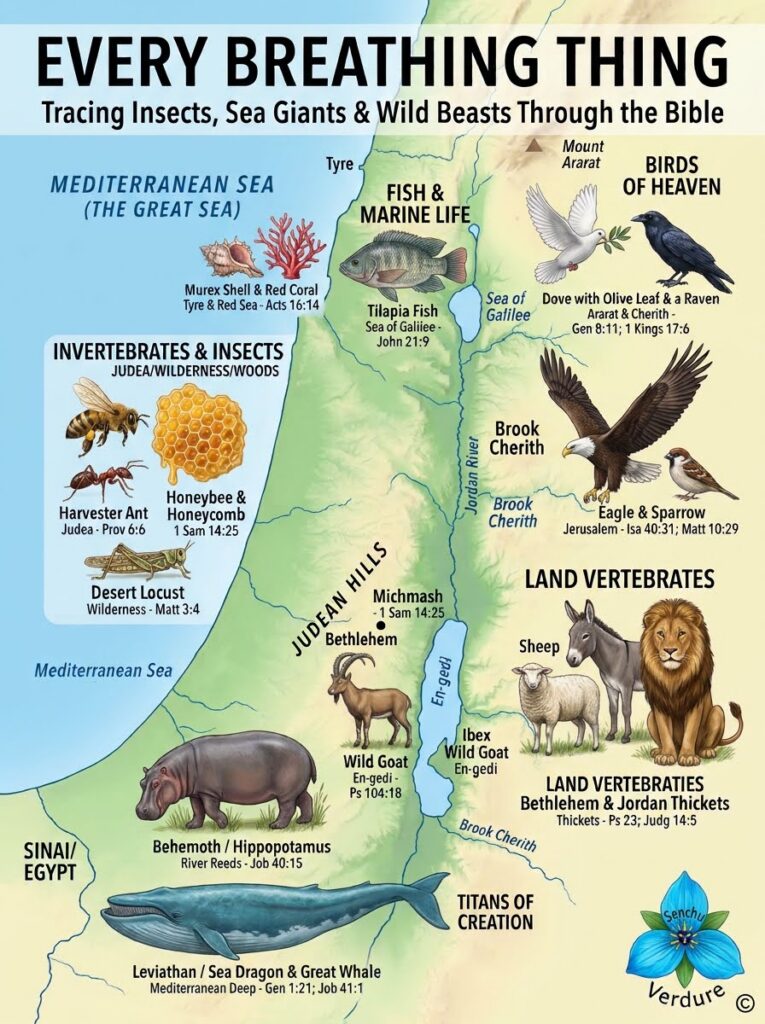
What unites the flyers, swimmers, four-legged walkers, and crawlers of the Hebrew Scriptures is that none of them exist in isolation—every single kingdom is interwoven with the plant realm.
The honeybee depends on wildflower nectar; the dove seeks out the resilient olive branch; Behemoth rests beneath the shade of river lotus trees and willows (Job 40:22); the little foxes roam the blooming vineyards; the ant harvests summer grains; the horned viper shelters beneath desert brush; the crimson tola’ath clings to the oak; and the herds graze upon the green herbs given for food in Genesis 1:30. Even the great trees of the Hebrew Bible—the cedars of Lebanon, the date palms, and the sycamore figs—serve as nesting sanctuaries for the birds of the air (Psalm 104:12).
Concluding Reflection
From Behemoth resting calmly among the river reeds and the silent glide of a horned viper through dry sand, to the great sea creatures of the deep and the sparrow nesting near the temple altar, the Hebrew Scriptures invite us to look closely at every tier of creation with wonder and reverence. As Job 12:7–10 reminds us: “But ask the beasts, and they will teach you; the birds of the heavens, and they will tell you; or the bushes of the earth, and they will teach you; and the fish of the sea will declare to you. Who among all these does not know that the hand of the Lord has done this? In his hand is the life of every living thing and the breath of all mankind.”
Just as every root, leaf, and blossom in our gardens plays a quiet, indispensable role in sustaining life, every flyer, crawler, swimmer, and four-legged walker in the biblical world testifies to an intricate, living symphony crafted by the Creator’s hand.