
When we think of intelligence, we usually think of brains, nervous systems, and conscious thought. But look closely at the flora right around us and you will discover a mathematically precise form of evolutionary genius. Beneath the surface, plant intelligence operates on a magnificent blueprint where mathematics and life seamlessly intertwine, utilizing phyllotaxis to quietly shape our surroundings through an ancient, silent codeThe Invisible Architecture: Helical Staircases Within
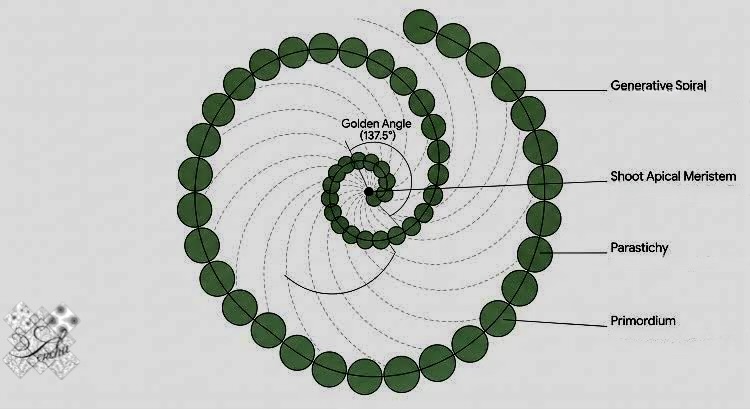
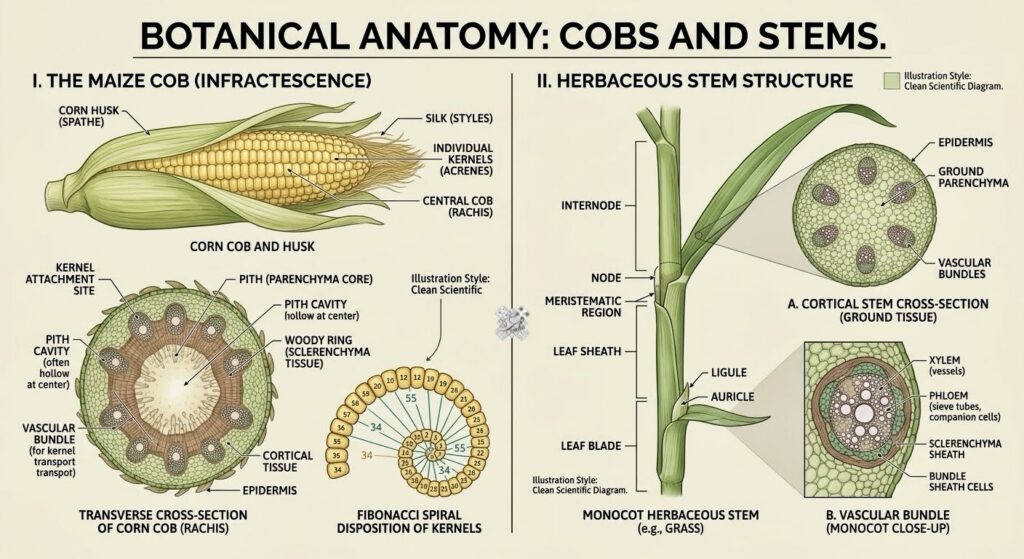
Hidden in plain sight, the natural world operates on a magnificent blueprint where mathematics and life seamlessly intertwine. Beneath the green surface of every stem and cob lies a flawless, three-dimensional plumbing grid governed by Fibonacci mathematics and spiral geometry, transforming how we view the flora around us. Instead of running in rigid, predictable lines, these internal transport tubes wind upward like tiny helical staircases, twisting at precise intervals to perfectly connect with leaves and seeds growing at the mathematical Golden Angle of 137.5 degrees on the outside.
This brilliant structural packing creates a natural density gradient—clustering tough, fiber-sheathed bundles tightly along the outer edge while spacing larger ones out toward the center—forming an incredibly lightweight, flexible cylinder that acts like internal structural rebar to keep the plant standing strong. Once you understand this ancient, silent code, it will completely open your eyes to the mesmerizing geometric patterns hidden all around us, whether you are harvesting vegetables in your home garden, browsing the produce aisles of the grocery store, or simply enjoying a quiet walk in the park.
Spotting the Matrix Across the Plant Kingdom
Once you learn to recognize this mathematical blueprint, your daily routine transforms into an exploration of geometry. The Fibonacci sequence isn’t confined to textbooks; it is a living, breathing design standard that forms a universal spotting matrix across the plant kingdom:
- Sunflowers & Dandelions: Interlocking seed discs pack florets along opposing curves, maximizing seed count with zero gaps.
- Romanesco Broccoli: A spectacular structural fractal where every single cone bud is composed of smaller, identical self-similar spirals.
- Pinecones & Artichokes: Rigid, overlapping scales and bracts shingle outward following perfect logarithmic helices to protect developing seeds.
- Pineapples & Cherimoyas: Individual fruitlets aggregate along multiple intersecting axes to create a mathematically optimized, protective outer rind.
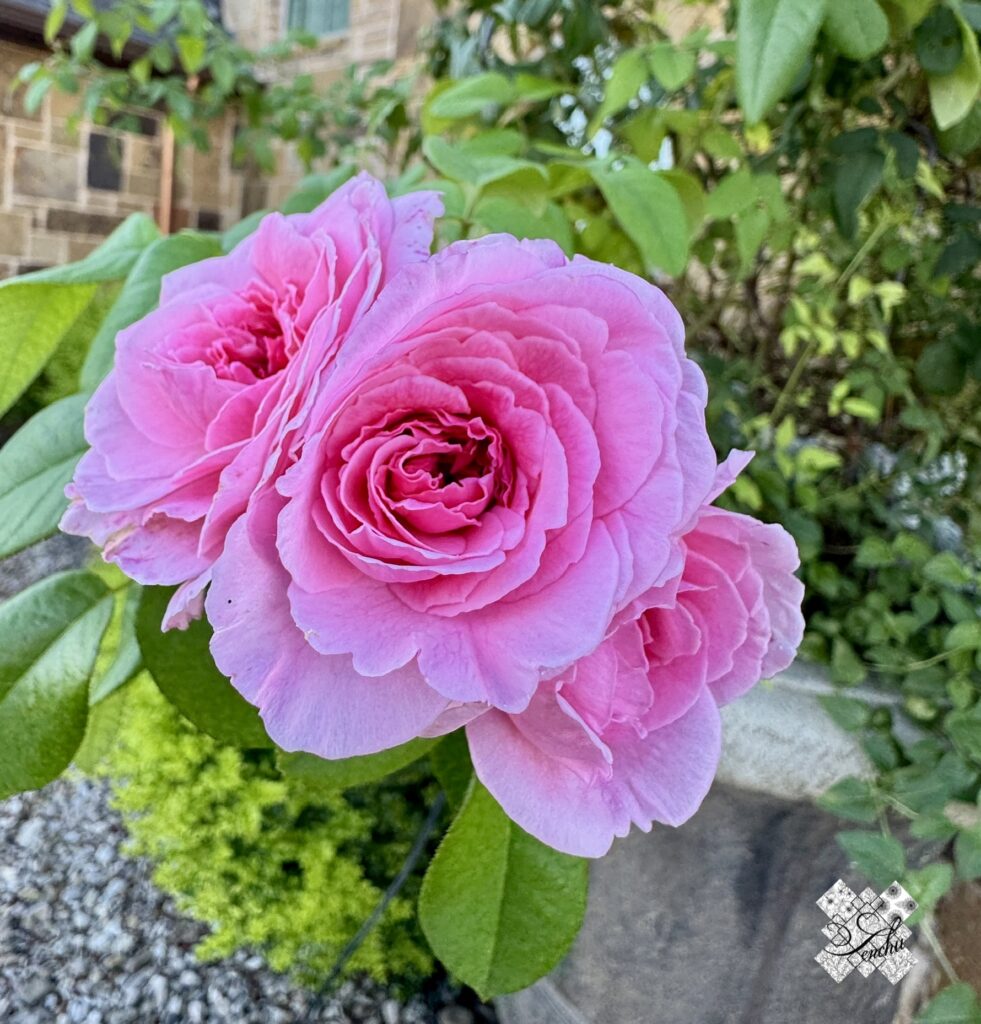
- Rosebuds & Lotus Buds: Petals utilize a nested, imbricate shingling arrangement to tightly pack around the central reproductive core before blooming.
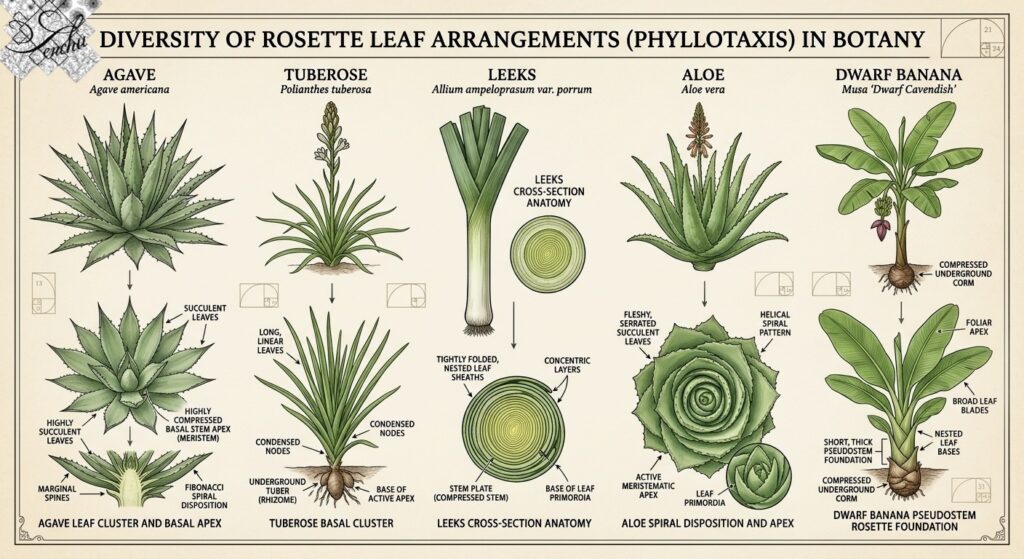
- Succulents (Echeveria & Aeonium): Fleshy leaf blades minimize node gaps to assemble a dense, watertight shield.
- Cabbage: A highly compressed terminal bud where broad, wavy leaves telescope over one another in a dense internal spiral layer.
- Corn: Kernel rows form a precise, high-density grid that traces a long, subtle spiral down the length of the central cob.
Fraction Math in Common Houseplants
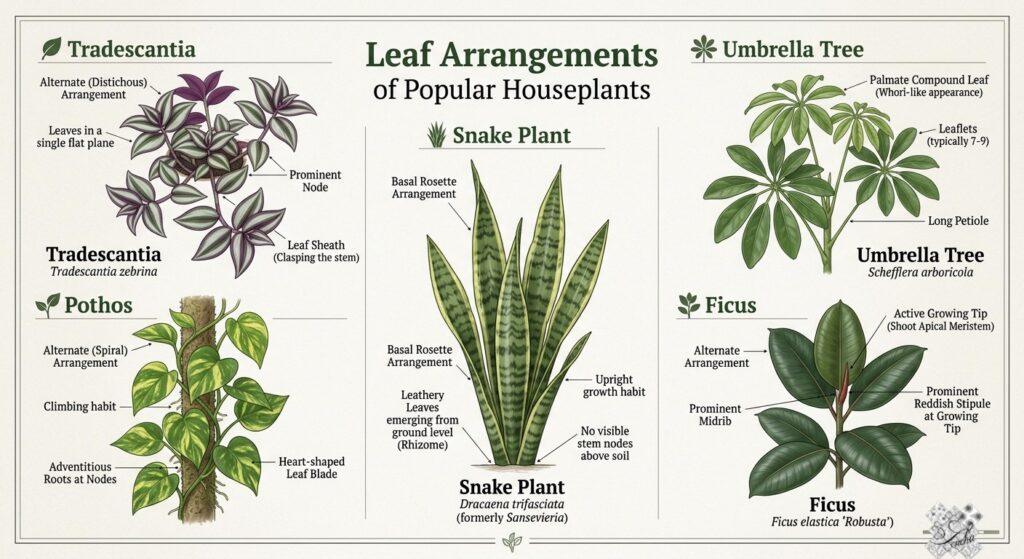
You don’t need an exotic greenhouse to witness this intelligence; the plants around us in our homes display strict mathematical fractions’ math through their stem nodes and leaf arrangements:
- Pothos (Epipremnum aureum): Displays an alternate spiral phyllotaxis, staggering leaves along a winding path to spread weight evenly around a trellis or climbing pole.
- Tradescantia (Tradescantia zebrina): Follows a strict alternate distichous pattern, flatly offsetting leaves at a \(1/2\) fraction (\(180^{\circ }\) turns) on a single two-ranked plane.
- Ficus (Ficus elastica): Large, leathery leaves use fractions like \(2/5\) or \(3/8\) to wind up a sturdy vertical trunk, preventing upper leaves from casting direct shadows down on the lower tiers.
- Umbrella Plant (Schefflera arboricola): Employs compound palmate whorls, radiating a wheel of 7 to 9 leaflets from a single tip to act as a wide, structural light trap.
- Snake Plant (Sansevieria trifasciata): Lacks an elongated stem entirely, anchoring its stiff, upright swords in a dense basal rosette that pushes outward sequentially from an underground rhizome.
Deciphering the Grid: How to Count the Spirals
Understanding the morphological geometry of plants allows you to actively crack the hidden code and count the math lines yourself. When analyzing a botanical grid or spiral matrix, you will notice diagonal rows winding in opposite directions. To decipher the pattern, follow these real-world steps:
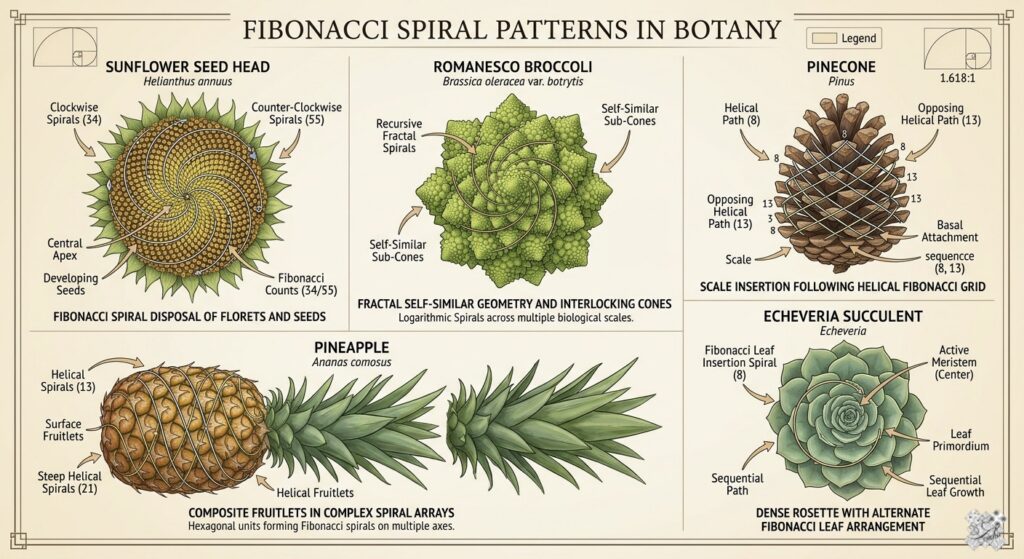
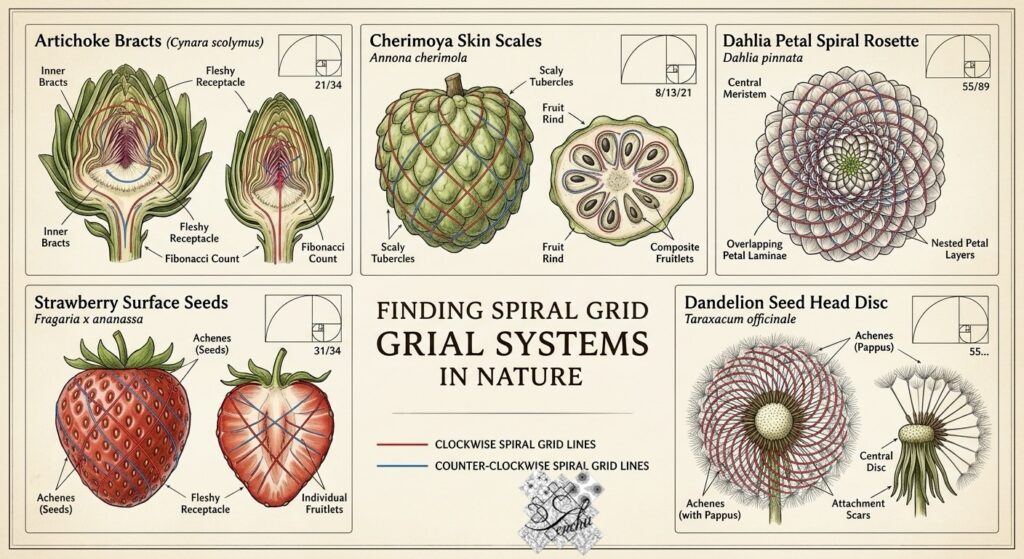
- Pinecones & Artichokes: Find a scale at the base. Trace the rows of scales wrapping steeply upward to the right (clockwise), then count the matching set wrapping to the left (counter-clockwise). You will routinely find combinations like 5 and 8 or 8 and 13.
- Rosette Succulents & Cabbages: Count the distinct spiral arms spiraling out from the center eye. The alignment of alternating leaf layers creates intersecting pathways that consistently match consecutive numbers like 8 clockwise and 13 counter-clockwise.
- Corn Cobs: Look at the base of the ear and trace the rows of kernels as they run the length of the cob. While they appear straight, they curve around the core in a long, high-density helical grid, typically tracking in groups of 8, 14, or 16 rows.
If you count these intersecting paths, you will discover that the two totals are almost always two consecutive numbers found in the Fibonacci sequence. This flawless spatial strategy demonstrates an inherent, adaptive plant intelligence, packing the maximum amount of biological structure into the tightest possible area to ensure optimal access to sun, air, and moisture. Ultimately, it is a stunning reminder that nature’s most sophisticated engineering is often completely invisible from the outside, quietly anchoring the beautiful symmetry of life..