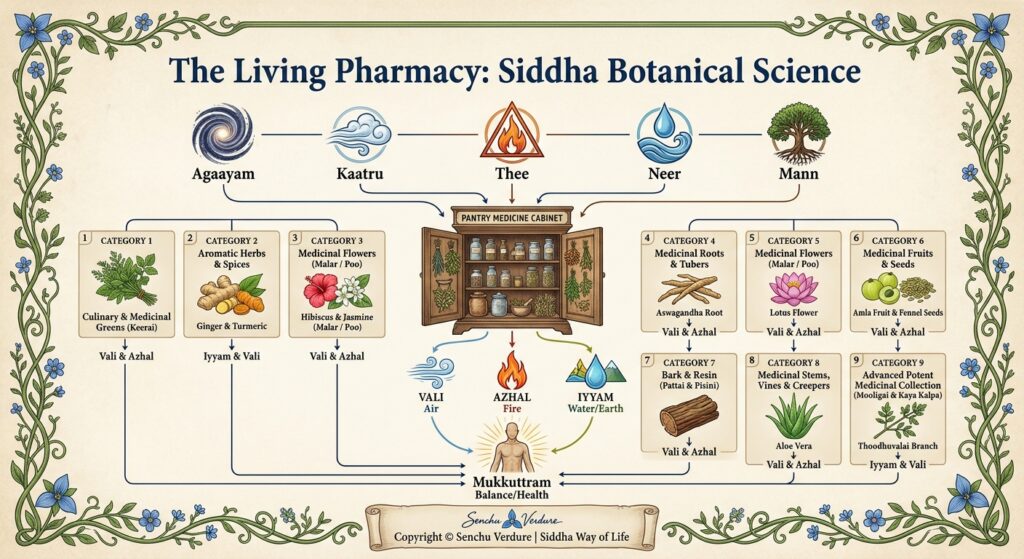
When we step into a traditional South Indian kitchen, we are not merely surrounded by culinary ingredients—we are standing inside a living pharmacy. Guided by the timeless Siddha maxim “உணவே மருந்து; மருந்தே உணவு” (Food is medicine; medicine is food), every seed, leaf, root, and bark holds a deliberate elemental purpose.
In Tamil Siddha tradition, a plant’s name is rarely just a label. Embedded in the Tamil language is a botanical blueprint—describing how a plant grows, how it interacts with the body’s internal elements, or the exact healing action it performs. Everything in our universe and our biology is an expression of the Panchabhootham (Five Elements): Nilam (Earth), Neer (Water), Thee (Fire), Kaatru (Air), and Agaayam (Ether). Through the process of Panchikarana (fivefold combination), these elements condense into our three governing humors (Mukkuttram): Vaadham (Air + Ether), Pitham (Fire), and Kabham (Earth + Water).
To help navigate this rich botanical wisdom without feeling overwhelmed, we can organize our kitchen and garden pharmacy into three distinct tiers based on daily accessibility and medicinal potency—and look closely at the stories hidden inside their Tamil names.
Tier 1: The Daily Anjaraipetti (The Essential Spice Box)
The Anjaraipetti is our first line of daily constitutional defense. These foundational seeds, bulbs, and rhizomes regulate digestive fire (Thee) and prevent elemental imbalances before they take root.
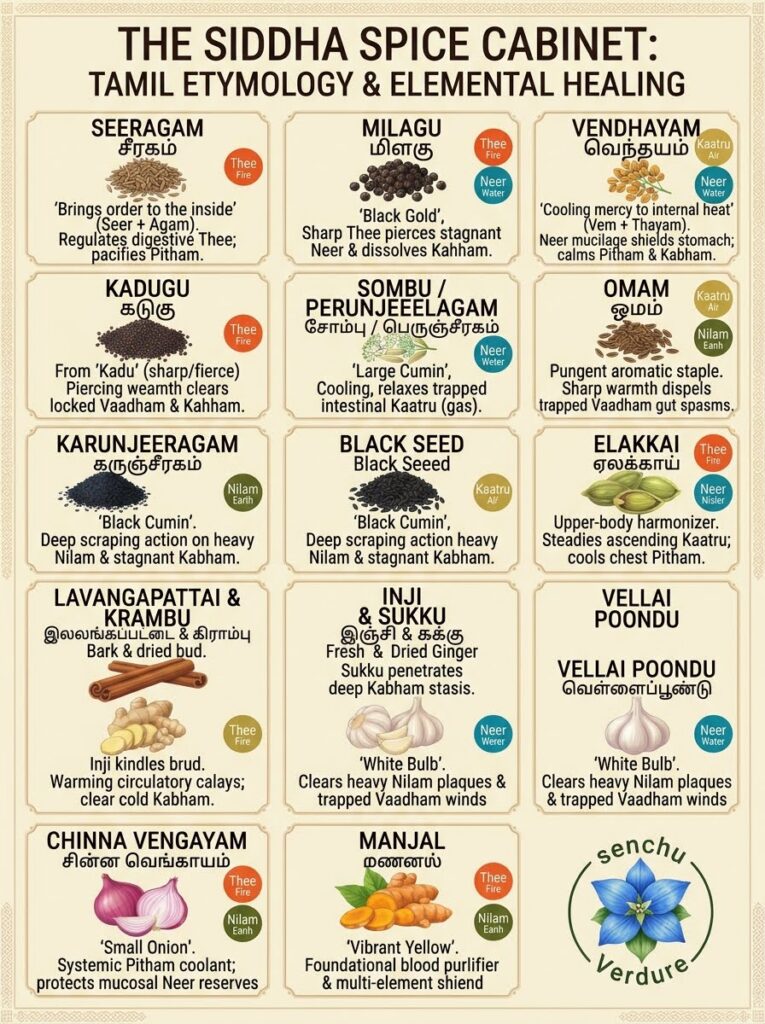
- Seeragam (சீரகம்) — Cumin Seeds: Derived from Seer (harmony/order) and Agam (the interior/stomach). Literally, “that which brings order to the inside.” It regulates digestive Thee and pacifies excess Pitham without aggravating internal heat.
- Milagu (மிளகு) — Black Pepper: Rooted in the classical Tamil word Milagu, prized historically as “black gold.” It uses sharp Thee and drying attributes to pierce heavy, stagnant Neer and dissolve excess Kabham.
- Vendhayam (வெந்தயம்) — Fenugreek: Associated with Vem (heat) and Thayam (mercy/cooling relief)—meaning “that which offers cooling mercy to internal heat.” Its lubricating Neer mucilage shields the stomach lining and calms both Pitham and Kabham.
- Kadugu (கடுகு) — Mustard Seeds: From Kadu (sharp, pungent, or fierce). Its rapid, piercing warmth breaks through cold, stagnant Neer and clears locked Vaadham and Kabham.
- Sombu / Perunjeeragam (சோம்பு / பெருஞ்சீரகம்) — Fennel Seeds: Perunjeeragam translates to “Large Cumin” (Periya = big + Seeragam = internal harmonizer), highlighting its shared cooling, digestive-ordering role in relaxing trapped intestinal Kaatru (gas).
- Omam (ஓமம்) — Carom Seeds: A pungent aromatic staple whose sharp warmth (Ushna Veeryam) immediately dispels trapped Vaadham spasms in the gut.
- Karunjeeragam (கருஞ்சீரகம்) — Black Seed: Literally “Black Cumin” (Karuppu = black + Seeragam), distinguished by its deep scraping action on heavy Nilam accumulations and stagnant Kabham.
- Elakkai (ஏலக்காய்) — Cardamom: From Elam (cardamom) and Kaai (pod/fruit), an upper-body harmonizer that steadies ascending Kaatru and cools localized chest Pitham.
- Lavangapattai (இலவங்கப்பட்டை) & Krambu (கிராம்பு) — Cinnamon & Cloves: Pattai refers to tree bark, while Krambu denotes the dried flower bud—both acting as warming circulatory catalysts to clear cold Kabham.
- Inji (இஞ்சி) & Sukku (சுக்கு) — Fresh & Dried Ginger: Inji refers to the moist, fresh rhizome that kindles salivary Thee and clears stomach dampness, while Sukku signifies the dried root whose concentrated warmth penetrates deep Kabham stasis.
- Vellai Poondu (வெள்ளைப்பூண்டு) — Garlic: Literally “White Bulb/Clove” (Vellai = white + Poondu = bulbous herb), famous for clearing heavy Nilam plaques and trapped Vaadham winds.
- Chinna Vengayam (சின்ன வெங்காயம்) — Shallots: Literally “Small Onion” (Chinna = small), revered as a systemic Pitham coolant that protects mucosal Neer reserves.
- Manjal (மஞ்சள்) — Turmeric: Named for its vibrant yellow hue (Manjal = yellow), serving as our foundational blood purifier and multi-element shield.
Tier 2: The Culinary Kitchen Garden (The Aromatic Trio & Daily Keerai)
Moving from the spice box to fresh foliage, this tier nourishes tissues daily and keeps seasonal elements balanced through cooked greens and gourds.
The Essential Culinary Aromatic Trio
In daily South Indian cooking, three fresh herbs work together as an inseparable aromatic foundation:
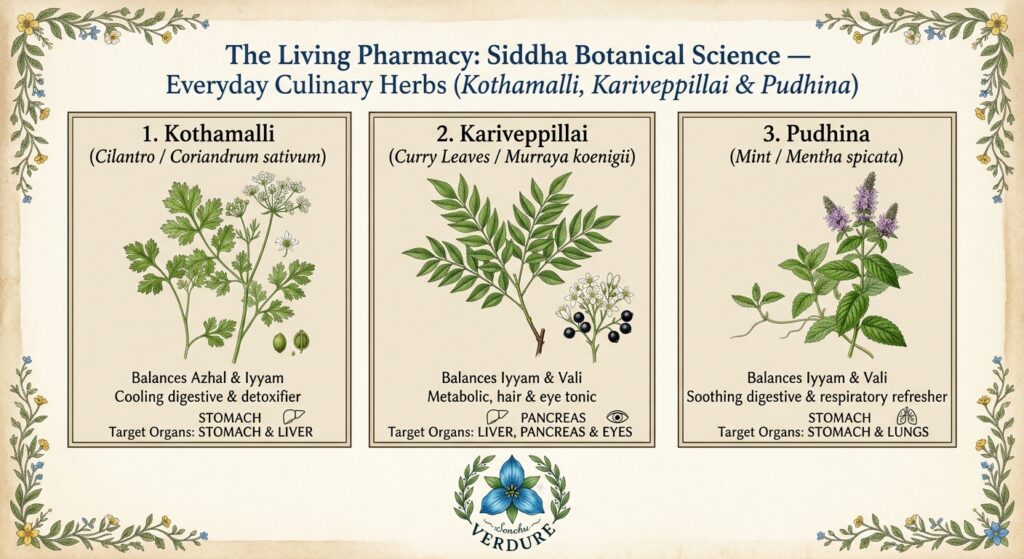
- Kothamalli (கொத்தமல்லி) — Coriander: Cooling and flushing, it clears urinary heat and keeps systemic Pitham in balance.
- Karuveppilai (கறிவேப்பிலை) — Curry Leaf: From Kari (spiced dish/broth), Vembu (neem-like medicinal potency), and Ilai (leaf)—literally “the medicinal leaf used in daily cooking.” It anchors unstable Pitham and supports healthy liver function.
- Pudhina (புதினா) — Mint: A crisp, cooling cleanser that slices through localized throat Kabham and refreshes the Agaayam (space) channels of the mouth and sinuses.
Daily Edible Greens (Keerai) & Nourishing Vegetables
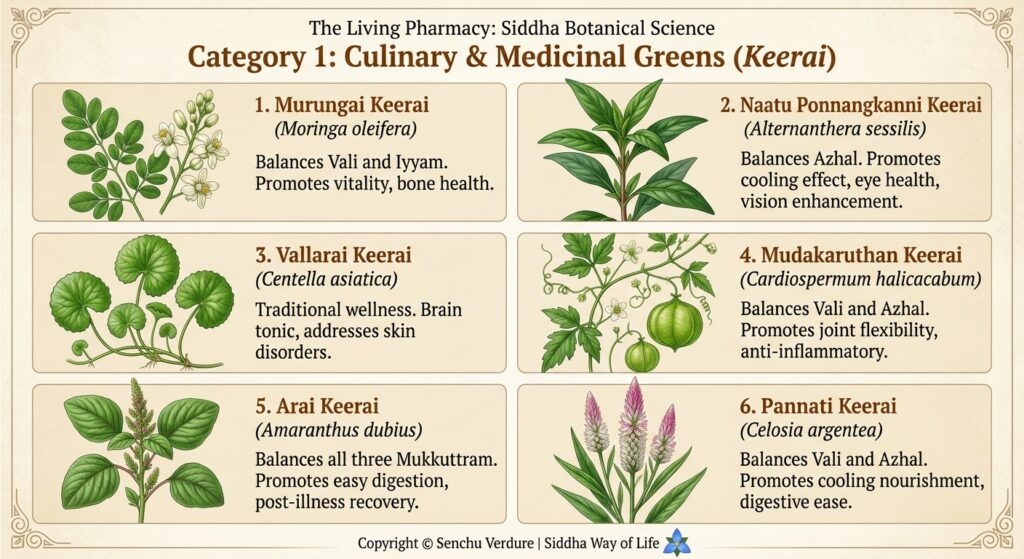
- Murungai Keerai (முருங்கை கீரை) — Moringa Leaves: From Murungu (to break/tender), referring to its brittle branches and pods; a powerhouse rebuilder of Nilam and Neer that corrects joint Vaadham.
- Ponnanganni Keerai (பொன்னாங்கண்ணி கீரை) — Sessile Joyweed: Derived from Pon (gold), Aam (becomes), and Kaan (see/body)—meaning “your body will gleam like gold” when consumed regularly. It draws burning Thee away from the eyes and brain, extinguishing excess Pitham.
- Manathakkali Keerai (மணத்தக்காளி கீரை) — Black Nightshade Leaves: From Manam (fragrance/aroma) and Thakkali (tomato-like berry), celebrated for soothing burning stomach Thee and healing oral and gastric ulcers.
- Araikeerai (அரைக்கீரை), Sirukeerai (சிறுகீரை) & Mullaikeerai (முளைக்கீரை): Arai (half/stem-regrowing), Siru (small/delicate), and Mullai (tender/sprouting)—each variety offers gentle, digestible nourishment to flush excess vascular heat or support mucosal linings without triggering heavy Kabham.
- Venpoosani (வெண்பூசணி) — Ash Gourd: Literally “White Pumpkin” (Ven = white + Poosani = gourd), prized as an alkaline coolant (Seetha Veeryam) that pacifies soaring Pitham and Vaadham.
- Kovakkai (கோவக்காய்) — Ivy Gourd: Named for the scarlet-red hue (Kovvai) of its ripened fruit, acting as a blood-filtering protector that quiets inflammatory Thee.
Tier 3: The Advanced Potent Medicinal Collection (Kayakalpa & Targeted Botanicals)
Reserved for deeper clinical restoration and seasonal immunity, these potent herbs carry descriptive Tamil names that directly reveal their therapeutic mastery:
- Thulasi (துளசி) — Holy Basil (Ocimum sanctum): Placed at the forefront of our advanced medicinal collection, Thulasi stands for “the incomparable one.” Its warming potency (Ushna Veeryam) clears deep chest Kabham, purifies blood lanes, and protects cranial Agaayam and vital breath (Pranan).
- Seenthil (சீந்தில்) — Guduchi: From Seenthil (to drip/exude nectar), reflecting its reputation as a rejuvenating Kayakalpa vine that harmonizes all three humors (Mukkuttram) and clears deep-seated tissue toxins (Nanjukal).
- Amukkira (அமுக்கிரா) — Ashwagandha: Rooted in Amukku (to press down, ground, or settle), describing its supreme ability to press down erratic, unanchored Vaadham and restore deep Nilam stability to the nervous system.
- Thanneer Vittan Kilangu (தண்ணீர்விட்டான் கிழங்கு) — Wild Asparagus: Literally “the tuber that releases water” (Thanneer = water + Vittan = released + Kilangu = tuber). Its succulent roots restore pure Neer moisture to dried tissues and soothe overheated Pitham.
- Sirukurinjan / Sakkarakolli (சிறுகுறிஞ்சான் / சர்க்கரைக்கொல்லி) — Gymnema: Sakkarakolli literally translates to “Sugar Destroyer” (Sakkara = sugar + Kolli = destroyer), named for its remarkable ability to temporarily mute sweet taste receptors and clear sticky Kabham stagnation in blood pathways.
- Mudakathan Keerai (முடக்கத்தான் கீரை) — Balloon Vine: Formed from Mudakku (stiffness/joint lock) and Aruthan (that which severs/relieves)—literally “the herb that breaks joint stiffness.” It is the premier Siddha remedy for releasing frozen Kaatru and chronic Vaadham pain from the joints.
- Thoothuvalai (தூதுவளை) — Climbing Brinjal: Derived from Thoothu (messenger) and Valai (net/vine)—known as “the messenger vine” because it clears heavy Kabham blocks from the throat and chest to restore a clear, resonant voice.
- Aadathodai (ஆடாதோடை) — Malabar Nut: From Aadu (goat) and Thodai (will not touch)—meaning “the leaf that not even a goat will browse” due to its intense bitterness, which makes it unmatched at liquefying stubborn respiratory Kabham.
- Karisalai / Karisalaankanni (கரிசாலை) — False Daisy: Linked to Kari (jet black), celebrated for restoring dark pigment to graying hair while protecting the liver (Kallieeral) and stabilizing Pitham.
- Vetpalai (வெட்பாலை) — Sweet Indrajao: From Ven (white) and Paalai (milky-sap tree), a specialized dermal remedy whose astringent, cooling nature heals scaling skin conditions and calms local Pitham lesions.
- Avarai / Avarampoo (ஆவாரை / ஆவாரம்பூ) — Tanner’s Cassia: Reflected in the classic Tamil proverb “Aavarai poothirukka saavarai kandathundo?” (Have you ever seen anyone wither while Avarai is in bloom?), honoring its role in anchoring Pitham and Kabham and stabilizing urinary Neer.
- Nannari (நன்னாரி) — Indian Sarsaparilla: From Nal (good/fragrant) and Naari (root)—literally “the good fragrant root” that cools vascular Pitham and purifies blood fluids.
Harvesting from the Living Pharmacy: Timing and Care
Harvesting medicinal herbs is as much about timing as it is about technique. Because a plant concentrates its volatile essential oils (thailam compounds) in response to sunlight and temperature, mid-morning—just after the morning dew has evaporated, yet before the midday sun peaks—offers the highest potency for leafy herbs like Thulasi (Ocimum sanctum) and Karpooravalli.
- Snip Just Above a Leaf Node: Use clean, sharp shears to cut stems right above a pair of leaves. This encourages the plant to branch out into fuller, healthier growth rather than stressing the main stem.
- Respect the One-Third Rule: Never harvest more than one-third of a perennial plant at one time. Leaving plenty of foliage ensures the plant can continue photosynthesis and store energy in its roots.
- Roots and Seeds Follow Their Own Clock: Harvest roots like Sukku (ginger) or Manjal (turmeric) in autumn once the upper foliage dies back and energy returns below ground. Gather seeds early in the morning before dry pods split open in the afternoon heat.
Botanical Quote: “The plants have enough spirit to transform our limited vision.” — Robin Wall Kimmerer
In Closing: Harvesting with patience and restraint turns a simple morning walk through the garden into a sustainable exchange—honoring the plant’s life cycle while gathering potent, fresh medicine for your pantry.
Biblical Quote: “To everything there is a season, and a time to every purpose under the heaven: a time to be born, and a time to die; a time to plant, and a time to pluck up that which is planted.” — Ecclesiastes 3:1–2
This catalog and botanical framework are inspired by the teachings of Dr. Saalai Jaya Kalpana and Dr. Saalai Maruthamalai Murugan (Siddha Mudra and Ayush Health Research and Training Academy — SMARTA). Always consult a qualified Siddha practitioner before using potent medicinal herbs for therapeutic care.