அற்றது போற்றி உணின்அமிர்தம் ஆகும்;
உற்றது உணராமல் உண்ணின் விடம் ஆகும்.”
(When food is eaten mindfully after the previous meal has digested, it becomes life-giving nectar; when eaten without understanding the body’s digestive state, it turns into toxin. — Traditional Tamil Siddha Wisdom)
“உணவே மருந்து; மருந்தே உணவு”
(Food is medicine; medicine is food. — Classical Tamil Siddha Maxim)
In the plant realm, certain seeds, roots, and resins work in harmony to kindle the body’s internal metabolic fire. In Tamil Siddha medicine, Ashta Chooranam is a revered eight-ingredient polyherbal powder designed to balance Vali (வளி / wind) and Iyam (ஐயம் / sluggishness) while gently stimulating Azhal (அழல் / digestive heat).
In Western medical terms, this formulation acts as a potent carminative (relieving flatulence), antispasmodic(easing abdominal cramping), and thermogenic digestive stimulant (enhancing enzymatic activity and metabolic heat). When our pantry functions as our medicine cabinet, this foundational blend becomes a daily ally for gut equilibrium.
Ingredients (Equal Parts Botanicals + Rock Salt to Taste)
Unlike commercial preparations that measure all eight components equally, this traditional method uses equal parts by weight (for example, 25 grams each) for the seven botanical ingredients, while Indhuppu(rock salt) is added strictly to taste.
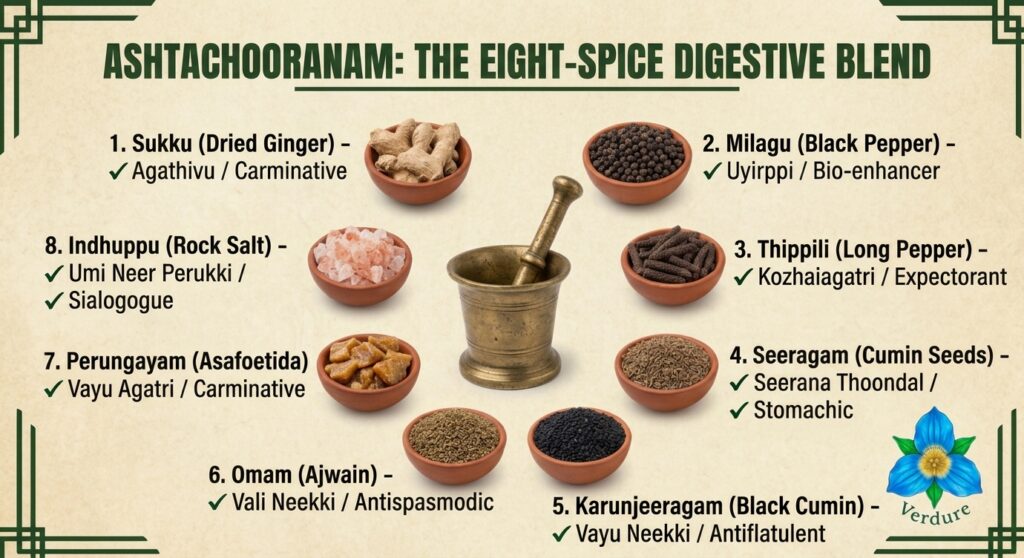
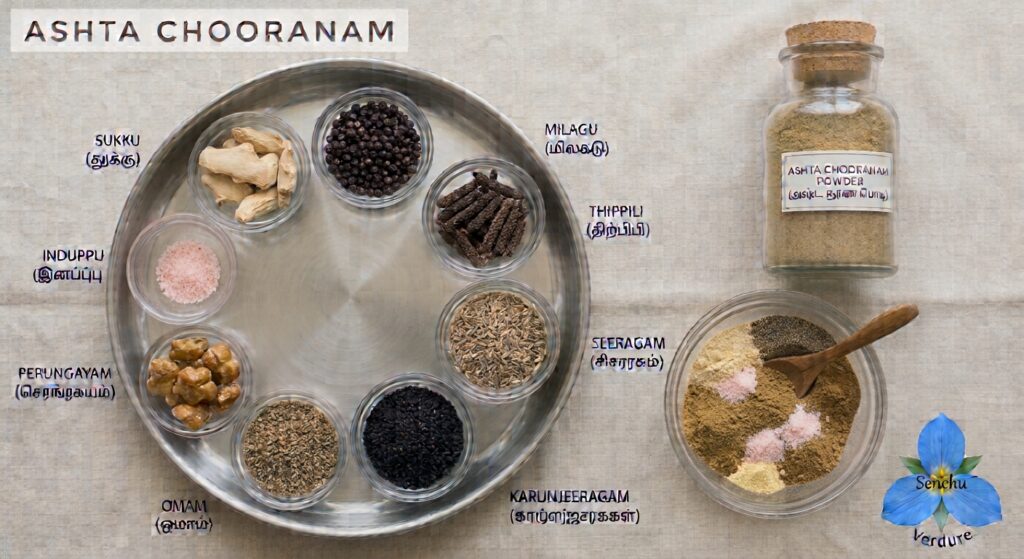
- Sukku (சுக்கு) — Dried Ginger (Zingiber officinale): A warming thermogenic and prokinetic root that stimulates gastric motility and clears sluggish digestion.
- Milagu (மிளகு) — Black Pepper (Piper nigrum): A bioavailability enhancer that awakens digestive enzymes and clears accumulated Iyam.
- Thippili (திப்பிலி) — Long Pepper (Piper longum): A pungent stomachic and carminative fruit spike that supports deep cellular absorption.
- Omam (ஓமம்) — Ajwain / Wild Celery (Trachyspermum ammi): A rich source of thymol that acts as an antispasmodic, rapidly relieving trapped gas and abdominal bloating.
- Jeeragam (சீரகம்) — Cumin Seeds (Cuminum cyminum): A cooling-yet-stimulating carminative that soothes the mucosal lining of the digestive tract.
- Karunjeeragam (கருஞ்சீரகம்) — Black Cumin (Nigella sativa): A gastroprotective and antimicrobialseed that regulates bowel motility and reduces fermentation in the gut.
- Paal Perungayam (பால் பெருங்காயம்) — Milk Asafoetida (Ferula assa-foetida): A purified, resinous gum that acts as a powerful antiflatulent, dispersing stagnant Vali in the lower abdomen.
- Indhuppu (இந்துப்பு) — Rock Salt (Halite): Added to taste; acts as a sialogogue (stimulating saliva and hydrochloric acid secretion) to initiate the first stage of digestion.
Traditional Preparation Method
To preserve the volatile essential oils and medicinal potency of the plant realm, each ingredient is prepared with mindful heat control rather than heavy frying:
- Dry-Toasting the Paal Perungayam: Heat a heavy-bottomed kadai over a low flame. Add the Paal Perungayam (milk asafoetida) and dry-toast it directly on the kadai—without using ghee or oil—until it puffs up, becomes crisp, and turns aromatic. Remove and let it cool completely.
- Gentle Dry-Roasting of Seeds and Roots: Separately dry-roast the Sukku (lightly crushed), Milagu, Thippili, Omam, Jeeragam, and Karunjeeragam over low heat just until warm and fragrant. Avoid scorching, as excessive heat destroys their thermogenic volatile oils.
- Grinding & Sieving: Once all seven botanicals have cooled to room temperature, grind them together into a fine, uniform powder. Pass the powder through a fine mesh sieve to remove coarse fibers.
- Incorporating Indhuppu: Lightly warm the Indhuppu in the kadai to remove any ambient moisture, grind it finely, and fold it into the herbal blend to taste.
- Storage: Store the finished chooranam in an airtight glass jar away from direct sunlight and moisture.
Traditional Usage & Pairing
- Dosage & Carrier (Thunai Marundhu): Traditionally, 1 to 2 grams (about ¼ to ½ teaspoon) is mixed with warm water, freshly churned buttermilk, or the first morsel of warm Samba rice with a drop of ghee to pacify aggravated Vali and support effortless digestion.
Disclaimer: This formulation is shared for educational and traditional culinary-wellness documentation purposes only and is not intended to diagnose, treat, cure, or prevent any medical condition. Consult a qualified healthcare practitioner before introducing concentrated herbal preparations into your routine, especially if you are pregnant, nursing, managing blood pressure, or taking prescription medications.
Attribution & Credits
- Recipe & Siddha Lineage Credit: Gratefully adapted from the teachings of Dr. Saalai Jaya Kalpana, Siddha Physician and Teacher, SMARTA Academy (Siddha Way of Life).
Botanical & Biblical Reflection
Just as the Creator designed the seeds and roots of the earth to carry hidden warmth and restoration for the body, tending to our internal health requires patience, balance, and reverence for nature’s order. “And the leaves of the tree were for the healing of the nations” (Revelation 22:2)—reminding us that every humble seed in our kitchen carries a quiet, purposeful grace.
