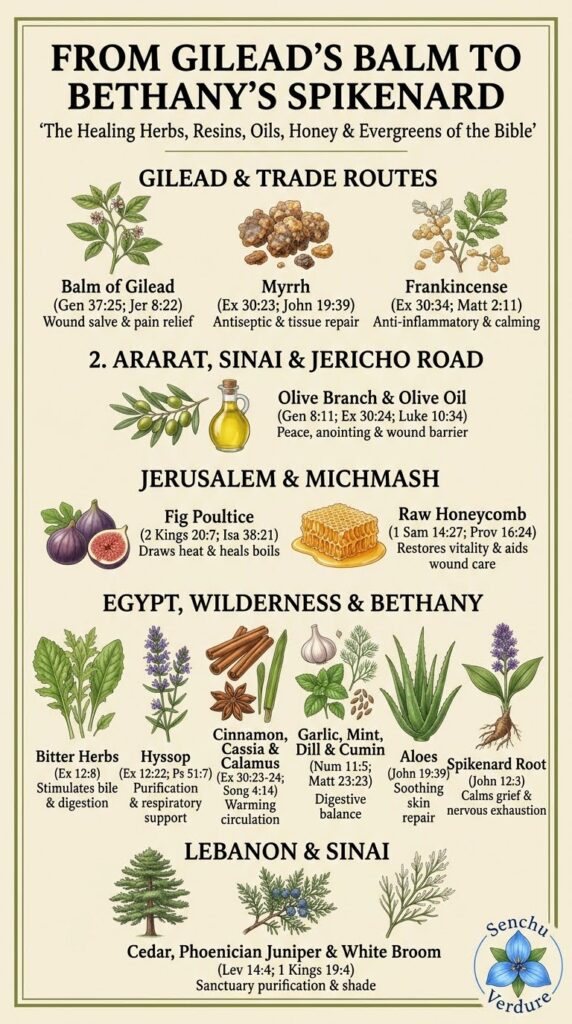
Across the pages of Scripture, healing plants are rarely mentioned in isolation. Instead, they are anchored to specific biblical lands, wilderness journeys, royal chambers, and quiet village homes—revealing how geography, climate, and sacred stewardship shaped ancient medicine. From the resin-bearing highlands east of the Jordan to the olive groves of Galilee and the evergreen slopes of Lebanon, every leaf, branch, bark, gum, and drop of wild honey stood as a tangible gift created for human nourishment and physical restoration.
“And by the river upon the bank thereof, on this side and on that side, shall grow all trees for meat, whose leaf shall not fade, neither shall the fruit thereof be consumed: it shall bring forth new fruit according to his months, because their waters they issued out of the sanctuary: and the fruit thereof shall be for meat, and the leaf thereof for medicine.”
— Ezekiel 47:12 (Vision of the Temple River in Jerusalem)
1. The Hill Country of Gilead & Trade Routes to Egypt: Healing Resins
East of the Jordan River lay the rugged, forested highlands of Gilead (in modern-day Jordan), a vital commercial hub along the ancient King’s Highway renowned for medicinal tree resins.
- Balm of Gilead (Pistacia atlantica / Commiphora species) — Gilead, Dothan, and Egypt.
In Genesis 37:25, Ishmaelite traders traveling from Gilead down to Egypt carry camels laden with spices, balm, and myrrh. Centuries later, the prophet Jeremiah laments over Judah: “Is there no balm in Gilead; is there no physician there?” (Jeremiah 8:22). Ethnobotanists identify this prized resin (zori in Hebrew) with aromatic oleoresins harvested in Gilead, such as the Atlantic pistachio (Pistacia atlantica), valued across the ancient Near East as a soothing topical salve for wounds and localized pain. - Myrrh (Commiphora myrrha) — Mount Sinai, Bethlehem, and Jerusalem.
First specified at Mount Sinai as a primary ingredient in the holy anointing oil (Exodus 30:23), presented by the Magi in Bethlehem (Matthew 2:11), and brought by Nicodemus to the tomb in Jerusalem (John 19:39), myrrh served as a potent antiseptic, astringent wound dressing, and pain-relieving draught. - Frankincense (Boswellia species) — Mount Sinai and Bethlehem.
Commanded at Mount Sinai for the sacred sanctuary incense (Exodus 30:34) and gifted in Bethlehem(Matthew 2:11), frankincense yields aromatic boswellic acids prized in antiquity for reducing swelling and calming physical and emotional distress.
2. Mount Ararat, Sinai, and the Jericho Road: Olive Branch & Pressed Olive Oil
Mentioned over two hundred times in Scripture, the cultivated olive tree (Olea europaea) bridges the earliest covenant signs after the flood with daily wound care, tabernacle worship, and prophetic restoration.
- The Olive Branch & Leaf — Mount Ararat and Jerusalem (Genesis 8:11; Nehemiah 8:15; Romans 11:17).
The first botanical sign of life after the great flood was a freshly plucked olive leaf carried back to Noah’s ark by a dove (Genesis 8:11), establishing the olive branch as the enduring emblem of peace and renewal. In Nehemiah 8:15, leafy branches of cultivated and wild olive were gathered alongside myrtle to build Feast of Tabernacles booths, while Romans 11:17–24 celebrates wild olive branches grafted into a nourishing root. Rich in antioxidant polyphenols like oleuropein, olive leaves have long been steeped into immune- and heart-supporting infusions. - Pure Olive Oil (Shemen Zayit) — Mount Sinai, Jerusalem, and the Jericho Road (Exodus 30:24; Luke 10:34; James 5:14).
At Mount Sinai, God designated pure beaten olive oil for the sanctuary lamps (Exodus 27:20) and as the carrier base for the holy anointing oil infused with myrrh, cinnamon, calamus, and cassia (Exodus 30:23–25). On the road from Jerusalem to Jericho, the Good Samaritan poured oil and wine into a wounded traveler’s injuries (Luke 10:34)—pairing wine’s mild antiseptic cleansing with olive oil’s soothing, moisture-sealing barrier—while James 5:14 commends anointing the sick with oil in prayer. Even the Garden of Gethsemane (Gat Shemanim, “olive oil press”) at the foot of the Mount of Olives reflects how pure healing oil emerges under pressure.
3. The Royal Palace of Jerusalem & Woodlands of Michmash: Fig Poultice & Raw Honey
Scripture records both an explicit topical poultice prescribed inside the royal palace in Jerusalem and the revitalizing power of wild honeycomb gathered in the woodlands of Israel.
- Fig Poultice (Ficus carica) — Jerusalem (2 Kings 20:7; Isaiah 38:21).
When King Hezekiah lay gravely ill with a painful boil in Jerusalem, the prophet Isaiah gave a direct botanical prescription: “Take a lump of figs. And they took and laid it on the boil, and he recovered” (2 Kings 20:7; mirrored in Isaiah 38:21). Pressed figs contain natural proteolytic enzymes (such as ficin) and soothing mucilage that soften hardened tissue, draw out localized heat, and support clean skin recovery. - Wild Honeycomb — The Forest near Michmash and Jerusalem (1 Samuel 14:25–29; Proverbs 16:24).
During battle near Michmash, Jonathan dipped his staff into wild forest honeycomb, ate it, and “his eyes were enlightened” (1 Samuel 14:27). In Proverbs 16:24, Scripture affirms honey’s restorative nature—“Pleasant words are as an honeycomb, sweet to the soul, and health to the bones”—while Proverbs 25:16 counsels wise moderation. Across ancient Mediterranean and Near Eastern medicine, raw unheated honey was also paired with crushed figs and aromatic oils in wound dressings for its osmotic, antimicrobial, and tissue-protecting properties.
4. Egypt, the Wilderness, and Bethany: Bitter Herbs, Spices & Sacred Roots
From the households of Egypt during the first Passover to the wilderness tabernacle, the temple courts of Jerusalem, and the homes of Bethany, sharp bitter greens, warming barks, and fragrant roots served both physical hygiene and spiritual remembrance.
- Bitter Herbs (Merorim) — Goshen in Egypt and the Wilderness (Exodus 12:8; Numbers 9:11).
God commanded Israel to eat roasted lamb and unleavened bread “with bitter herbs” at the Passover in Egypt (Exodus 12:8). Botanical historians and early Jewish oral tradition identify these sharp spring greens as wild lettuce (Lactuca serriola), chicory (Cichorium intybus), wild endive (Cichorium endivia), and sow thistle (Sonchus oleraceus). Beyond symbolizing the bitterness of bondage, bitter compounds stimulate taste receptors that trigger saliva, gastric acid, and bile flow—cleansing the liver and aiding the digestion of heavy roasted meats. - Biblical Hyssop (Origanum syriacum) — Goshen in Egypt, Mount Sinai, Jerusalem, and Golgotha.
Used in Egypt to brush Passover lamb’s blood onto doorposts (Exodus 12:22), prescribed in Sinai for cleansing skin conditions and homes (Leviticus 14:4), prayed over by King David in Jerusalem (Psalm 51:7), and raised to Jesus at Golgotha (John 19:29), true biblical hyssop (Ezov) is Syrian oregano (Origanum syriacum). Distinct from North American lavender-spiked anise hyssop (Agastache foeniculum), this low-growing Mediterranean herb bears fuzzy gray-green leaves and compact clusters of tiny white blooms rich in thymol and carvacrol, supporting respiratory clearing and microbial protection. - Cinnamon, Cassia, and Calamus (Cinnamomum verum, Cinnamomum cassia & Acorus calamus) — Mount Sinai and Jerusalem.
Specified at Mount Sinai in the sacred anointing oil (Exodus 30:23–24) and celebrated in Song of Solomon 4:14, these warming barks and sweet aromatic cane stimulate circulation, kindle metabolic thermogenesis, soothe digestive sluggishness, and clarify the mind. - Garlic, Mint, Dill, and Cumin — Egypt, the Wilderness, and Jerusalem (Numbers 11:5; Matthew 23:23).
Remembered from Egypt for physical strength (Numbers 11:5), garlic supports circulation and immune resilience, while the garden herbs mint, dill (“anise”), and cumin tithed in Jerusalem (Matthew 23:23) act as classic digestive carminatives. - Spikenard Root (Nardostachys jatamansi) and Aloes (Aquilaria / Aloe vera) — Bethany and Jerusalem.
In Bethany, Mary anointed Jesus’ feet with costly spikenard (John 12:1–3), an earthy root oil treasured for calming grief and nervous exhaustion, while in Jerusalem, Nicodemus brought a hundred-pound blend of myrrh and aloes (John 19:39), reflecting ancient reverence for both fragrant eaglewood and cooling, skin-soothing aloe.
5. Lebanon, Sinai, and the Holy Hills: Sacred Evergreens & Healing Leaves
Throughout Scripture, evergreen trees and shrubs symbolize enduring strength, sanctuary purification, and renewal in barren places—while their leaves carry tangible medicinal and restorative value.
- Cedar Wood and Phoenician Juniper (Cedrus libani & Juniperus phoenicea) — Lebanon, Sinai, and Jerusalem.
Towering cedars of Lebanon supplied rot-resistant, insect-repelling beams for Solomon’s Temple (1 Kings 5:6) and stood as a symbol of righteous longevity (Psalm 92:12). In the arid wilderness of Sinai, where true Lebanon cedars did not grow, biblical botanists identify the aromatic “cedar wood” (erez) bundled with hyssop in skin and household purification rites (Leviticus 14:4–7, 49–52) as Phoenician juniper (Juniperus phoenicea), whose heartwood contains antifungal and antibacterial sesquiterpenes. - White Broom (Retama raetam), the “Juniper” of Elijah — Wilderness of Beersheba (1 Kings 19:4–5; Psalm 120:4).
In older English translations, the exhausted prophet Elijah rests beneath a “juniper tree” (1 Kings 19:4–5), and Psalm 120:4 speaks of “coals of juniper.” Botanical scholars confirm the Hebrew rotem is the desert white broom, a green-stemmed shrub that casts life-saving wilderness shade and yields dense, long-burning charcoal coals. - Myrtle, Cypress, Pine, and Bay Laurel — Mount Carmel and Jerusalem (Nehemiah 8:15; Isaiah 41:19; Psalm 37:35).
Alongside olive and fig leaves, fragrant myrtle (Myrtus communis), cypress, pine, and bay laurel(Laurus nobilis, the “green bay tree” of Psalm 37:35) embody divine restoration—culminating in Ezekiel’s vision of sanctuary trees whose leaves never wither and serve “for medicine” (Ezekiel 47:12).
Ancient South Indian Parallels: The Siddha Tradition
This biblical reverence for healing landscapes and sacred aromatics finds a striking cultural parallel in the ancient South Indian Siddha tradition. Just as Scripture anchors remedies to specific regions like Gilead, Egypt, Lebanon, and Jerusalem, classical Tamil Siddhars such as Theraiyar taught that every leaf, root, wood, and resin absorbs the distinct qualities of its native soil (Mann), water (Neer), and sunlight (Thee) to restore balance among the body’s five elements (Agaayam, Kaatru, Thee, Neer, and Mann). Remarkably, several prized biblical botanicals are also cornerstones of the Siddha pharmacopeia: Himalayan Spikenard (Jatamanchi), carried along ancient trade routes to Bethany, is treasured in Siddha medicated oils (Thailam) for calming the mind and steadying nervous Vali, while resins like Frankincense (Parangi Sambrani), Myrrh (Vellaipolam), and fragrant Cedar (Devadaru) are used in traditional therapeutic fumigation (Pugai) and wound-healing salves (Kalimbu). Just as Exodus 30 infuses aromatic barks into pure olive oil, Siddha medicine crafts herbal Thailams in cold-pressed oils to nourish tissues deeply—while treating food as medicine, honoring raw honey as a catalytic carrier (Anupanam) in moderation, and pairing bitter greens (Kasappu) with warming spices like cinnamon to kindle digestive fire and cleanse the blood.
Closing Reflection
From the resin-bearing slopes of Gilead and the olive groves of Jerusalem to the quiet home in Bethany where spikenard filled the entire house, Scripture reveals that healing is never purely mechanical—it is an act of grace, stewardship, and reverence.
When we tend our gardens, prepare simple herbal infusions, or share nourishing food around our tables, we step into an unbroken sacred lineage—honoring the Creator whose trees still yield “the leaf thereof for medicine” (Ezekiel 47:12) and “leaves… for the healing of the nations”(Revelation 22:2).